
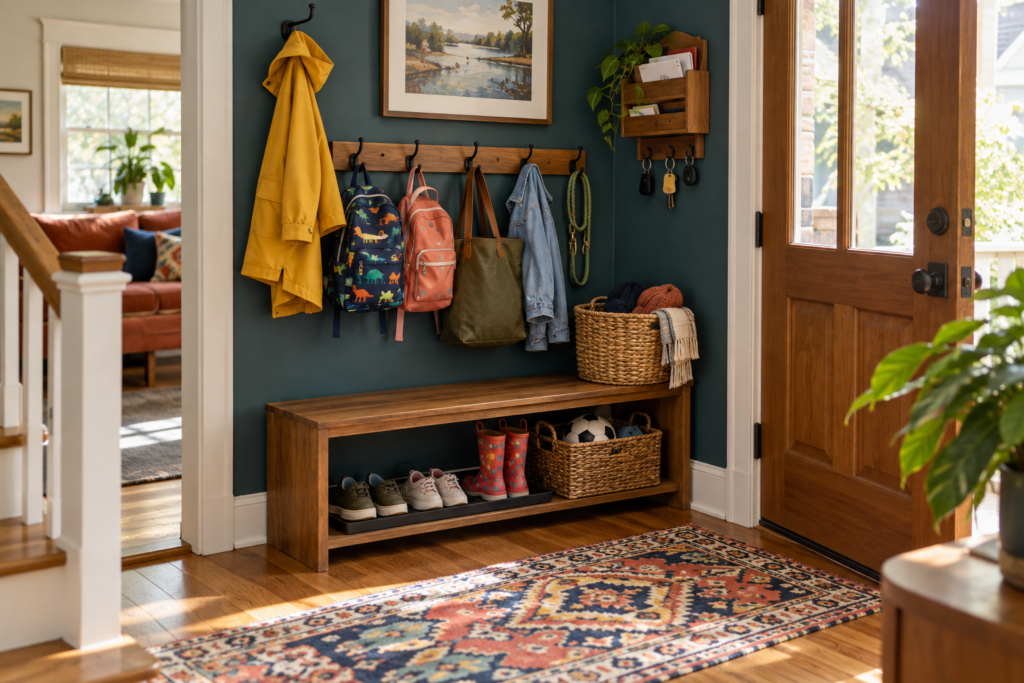
An empty entryway corner can quietly become one of the hardest-working spots in your home. Instead of collecting a migrating pile of shoes, backpacks, mail, and mystery jackets, it can give daily essentials a place to land before they spread across the kitchen counter.
A family drop zone doesn’t need a mudroom, custom cabinetry, or a renovation budget. It simply needs to match the way your household actually comes and goes. A small basket-and-hook setup may be plenty for one home, while another needs a bench, shoe tray, and separate backpack storage to keep weekday mornings from becoming a scavenger hunt.
The goal isn’t to create a picture-perfect entryway that nobody is allowed to touch. It’s to make arriving home and heading out the door a little easier.
Start With What Needs to Land There
Before bringing in bins, hooks, or a handsome hall tree that may or may not become a coat mountain, take stock of what regularly enters your home.
Most family drop zones need to handle a mix of:
- Shoes and boots
- Coats, rain jackets, and hats
- Backpacks, work bags, or tote bags
- Keys, sunglasses, wallets, and transit cards
- Sports gear, library books, or school papers
- Dog-walking supplies
- Reusable shopping bags
- Mail that needs attention
Not every item needs permanent storage in the entryway. A drop zone works best when it holds things that are used often and needed near the door. If winter gear is only used a few months each year, for example, keep the everyday basics in the corner and store the off-season overflow elsewhere.
This little edit matters. Buying more containers without deciding what belongs in them just gives clutter assigned seating.
Think about the route your family takes when they walk in. Where do people naturally kick off their shoes? Is there a countertop where keys always land? Does someone head straight to the kitchen with a backpack still on? Your drop zone should work with those habits whenever possible, not ask everyone to take a ceremonial detour through the house.
Protect the Path In and Out
An entryway corner may be empty because it genuinely has room to spare—or because it is part of a necessary walkway. Measure before committing to furniture, especially in a narrow foyer, apartment entry, or hallway that connects to other rooms.
The drop zone should never block the front door, windows, stairs, or a planned way out of the home. The U.S. Fire Administration advises keeping doors and windows clear as part of a home fire escape plan. In practical terms, that means resisting the urge to park a bench, bulky basket, or overflowing shoe rack directly in the path of an exit.
If someone in your household uses a wheelchair, walker, stroller, or other mobility support, leave enough open floor space to move comfortably through the area. A 36-inch clear route is a useful accessibility-informed planning target when wheelchair passage is needed, though it is not a universal requirement for every private home. The right amount of clearance depends on your household and layout.
A few space-saving choices can make a small entry feel much calmer:
- Use wall hooks instead of a deep coat rack.
- Choose a narrow bench or slim shoe cabinet rather than a wide cubby unit.
- Mount a small shelf with a tray for keys rather than adding a console table.
- Use vertical space for bags and jackets.
- Keep the floor open by limiting baskets to one or two useful categories.
When the path stays clear, the drop zone feels like support—not one more obstacle to sidestep while carrying groceries.
Build the Drop Zone Around Daily Routines
The best setup is usually made of a few simple zones, not one giant piece of furniture. Consider what your household needs to do when arriving home: hang something, put something down, remove shoes, and find important small items later.
A practical family drop zone often includes four functions.
A place to hang
Hooks are the workhorse here. They are easy for children to reach, useful for guests, and far more likely to get used than hangers tucked inside a closed closet. Give each person one hook if space allows, or designate hooks by category: everyday coats, bags, dog-walking supplies, and “take this with you” items.
If young children use the space, install a lower row of hooks for the things they can manage themselves. Adults can use an upper row for longer coats or less frequently used items.
A place to sit or set things down
A bench is helpful when people regularly put on shoes near the door. It can also make an entry feel more welcoming, even if it is simply a small stool or narrow wood bench.
No room for seating? A sturdy wall shelf, tiny ledge, or tray on a nearby surface can create a landing place for keys and sunglasses. The important part is giving small items an obvious home before they drift into the rest of the house.
A place for shoes
Shoes tend to multiply near the door because, frankly, they are doing their job. The solution is not necessarily to store every pair there. Keep the shoes currently in regular rotation in a low tray, open shelf, basket, or narrow cabinet, then move seasonal or occasional pairs elsewhere.
A shoe tray can be especially useful during wet weather because it helps contain dirt and moisture. If your household has several people, consider a simple limit: one or two pairs per person in the entryway. That keeps the corner functional without turning it into a tiny shoe store.
A place for the small but important stuff
Keys, mail, chargers, sunglasses, permission slips—these items create the most irritating kind of clutter because they are easy to lose and hard to replace in the middle of a rushed morning.
A shallow basket, small wall-mounted organizer, tray, or labeled drawer can help. Keep categories specific enough to be useful. “Mail” may be too broad; “mail to open” and “mail to recycle” create clearer next steps. Likewise, one small tray for keys works better than a decorative bowl that slowly fills with receipts, loose change, batteries, and one inexplicable Lego piece.
Choose a Setup That Fits Your Budget and Space
A functional entryway drop zone can be assembled gradually. Start with the pieces that solve the most annoying problem.
For a low-cost option, try a set of wall hooks, a washable basket, and a shoe tray. This works well in rental homes, small apartments, or homes where the entry is really just a section of hallway. Removable hooks may be useful in some rentals, but check the product instructions, weight limits, and your lease before installing anything.
For a modest upgrade, add a narrow bench with storage underneath or a slim cabinet that keeps shoes out of sight. A small mirror above the setup can make the corner feel more intentional and gives everyone one last chance to notice spinach in their teeth before leaving.
If you have more room, a hall tree or freestanding cubby unit can combine hooks, seating, and shoe storage in one footprint. These pieces are particularly useful for busy households because they make it easier to create individual zones for backpacks, coats, and outdoor gear.
Tall or top-heavy freestanding furniture needs a safety plan, especially around young children. The Consumer Product Safety Commission recommends anchoring furniture according to the manufacturer’s instructions and storing heavier items on lower shelves. Wall hardware should match the wall construction rather than being chosen at random; IKEA’s wall-anchoring guidance notes that suitable fasteners differ for stud-framed and solid walls. If you are unsure what is behind the wall or which hardware to use, ask a knowledgeable professional before proceeding.
Make It Look Intentional Without Making It Precious
An entryway drop zone is easier to maintain when it looks like it belongs in the room. That does not mean every basket needs to match or every backpack must disappear behind cabinet doors.
A few visual choices can make the setup feel calmer:
- Repeat one material, such as wood, black metal, woven baskets, or white bins.
- Use washable containers for dirty or damp gear.
- Pick labels that everyone can understand at a glance.
- Add a small rug or mat to define the area and catch everyday mess.
- Include one personal touch, such as a framed photo, small plant, or cheerful print, if it does not take up needed surface space.
Closed storage can make an entry look tidier, but open storage often works better for things that need to be grabbed quickly. A mix is usually the sweet spot: hooks and an open shoe tray for daily items, plus one drawer or basket for visual clutter.
Also, leave a little room for real life. A drop zone filled to the brim on day one has nowhere to absorb a wet umbrella, school project, or bag of groceries waiting to be carried farther into the house.
Give Each Person a Clear Role
Shared entryways become more manageable when everyone can tell where their things belong. This does not require a color-coded command center worthy of air-traffic control.
For younger children, a lower hook and basket with a simple picture label may be enough. Older kids might need a backpack hook, a spot for shoes, and a designated place for sports equipment or library books. Adults benefit from the same clarity, even if nobody says it out loud.
If several people share one compact corner, use names sparingly. Naming every hook can become annoying when routines change. Labels work best for stable categories, such as “returns,” “dog walk,” or “outgoing mail.” For flexible spaces, a row of identical hooks or baskets may be easier to adapt.
The system should also account for visitors and overflow. One spare hook and one empty basket can prevent the whole area from unraveling when someone comes in wearing a bulky coat on a rainy day.
Plan for the Reset, Not Perfection
Even a well-designed family drop zone will get messy. That is normal. It is the part of the home where everyone arrives carrying the evidence of their day.
Build a quick reset into your routine. Once or twice a week, return stray items to their rooms, recycle old papers, clean out the shoe tray, and check whether seasonal gear is taking over. During a busy stretch, simply clearing the floor and returning keys to their tray may be enough.
Pay attention to what keeps ending up outside the system. If backpacks always land beside the bench, the hooks may be too high or too crowded. If shoes spill into the hallway, the storage limit may be unrealistic. If mail still reaches the kitchen counter, the entryway mail spot may need to be closer to the door.
A good organization system can change as your household changes. That is not failure. It is maintenance.
Final Thoughts
An empty entryway corner can support one of the busiest transitions of the day: coming home. A few thoughtfully chosen places for coats, shoes, bags, and small essentials can reduce the daily scramble without demanding a bigger home or a major overhaul.
Start with the trouble spot you notice most often, then let the drop zone grow only as needed. The best version will look less like a showroom and more like a corner that makes ordinary family life run a little smoother.