
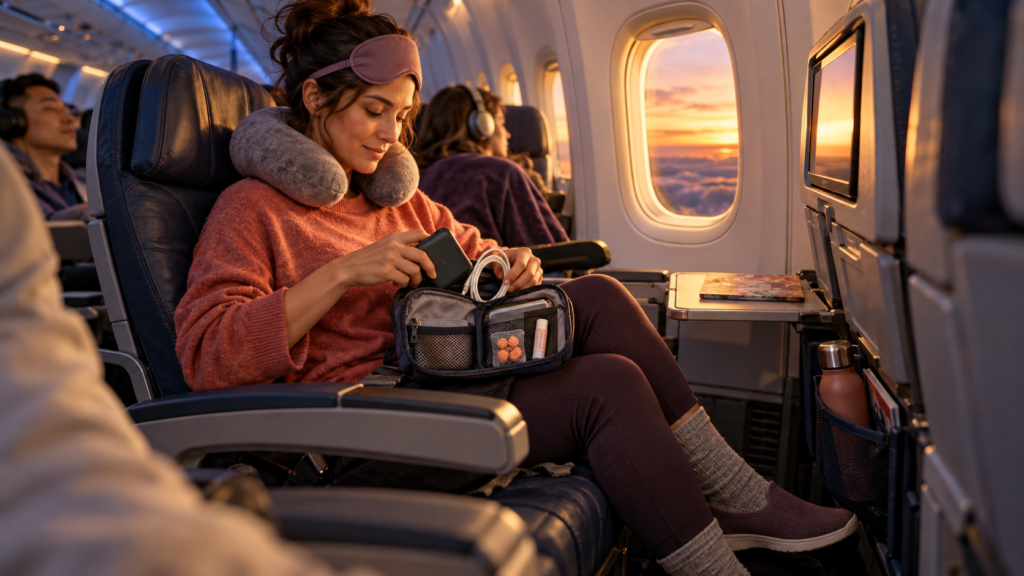
Long flights ask a lot of a very small space. The best long-flight travel accessories solve the little problems that become increasingly annoying after several hours: dry cabin air, bright lights, dead batteries, tangled cords, stiff legs, and essentials trapped in the overhead bin.
The best travel accessories that solve long flight problems aren’t necessarily the flashiest ones. They solve the annoying little problems that build up over several hours: dry air, bright cabin lights, dead batteries, tangled cords, stiff legs, and essentials that disappear into the overhead bin at exactly the wrong moment.
Some of these items are practical for nearly anyone, while others are comfort upgrades worth choosing based on your budget, health needs, seating arrangement, and tolerance for being mildly inconvenienced in public.
Affiliate disclosure: Some links in this article are affiliate links. If you make a purchase through an affiliate link, I may earn a commission at no additional cost to you. As an Amazon Associate I earn from qualifying purchases.
1. Properly Fitted Compression Socks for Long Periods of Sitting
Long stretches in an airplane seat can leave your legs feeling heavy, stiff, or generally unhappy with the arrangement. Properly fitted, below-the-knee graduated compression socks can be useful for some travelers, particularly those at increased risk of venous thromboembolism (VTE). Travelers without increased VTE risk generally do not need compression socks specifically for blood-clot prevention, although some may still prefer them for comfort. If you are unsure whether they are appropriate for you, ask a healthcare professional.
That said, they’re not a universal travel requirement, and they shouldn’t be treated as a guarantee against blood clots. The CDC notes that the overall risk of a travel-related blood clot is generally small. It also recommends moving your legs frequently and walking around when possible during long-distance travel. Travelers with a history of blood clots or other risk factors should speak with a clinician about appropriate precautions. The CDC’s guidance on blood clot risk and travel is a helpful starting point.
For many people, the basic strategy is refreshingly unglamorous: wear comfortable clothing, flex your ankles occasionally, and get up to walk when it’s safe to do so. Compression socks are not a substitute for movement or personalized medical advice.
2. A Sleep Eye Mask for Unpredictable Cabin Lighting
Evening flights, overnight flights, and flights where the person next to you is watching a very bright action movie at 2 a.m. can make resting difficult. A soft eye mask gives you some control over cabin light without requiring everyone else to follow your sleep schedule.
The CDC includes eye masks among the items that may help travelers nap during a flight. They won’t guarantee actual sleep, of course. Airplane rest is often more like “eyes closed while someone opens a bag of pretzels nearby.” Still, blocking overhead lights, window glare, and screen glow can make it easier to settle down.
Look for a lightweight mask with an adjustable strap rather than one that presses hard against your eyes. If you wear eyelash extensions, use a CPAP mask, or simply dislike anything touching your face, this may be a skip-it accessory rather than an essential.
3. Soft Earplugs for Cabin and Neighbor Noise
Airplane cabins have a steady soundtrack: engine noise, announcements, carts rolling down the aisle, crying babies, enthusiastic seatmates, and the occasional mystery rattle. Soft earplugs are one of the smallest and least expensive ways to reduce some of that background noise.
CDC travel guidance lists earplugs alongside eye masks as tools that may help with in-flight naps. They can also be useful if you’re sensitive to noise but don’t want to wear over-ear headphones for hours.
Foam or soft silicone earplugs take up almost no space, making them an easy backup even if you already plan to bring headphones. Just don’t expect total silence. They may, however, make the cabin feel less like you’re trying to rest inside a busy appliance.
4. A Carry-On Power Bank for a Dead Device
A fully charged phone is useful for far more than entertainment. It may hold your boarding pass, hotel address, transit directions, confirmation emails, emergency contacts, and the audiobook you downloaded with such good intentions.
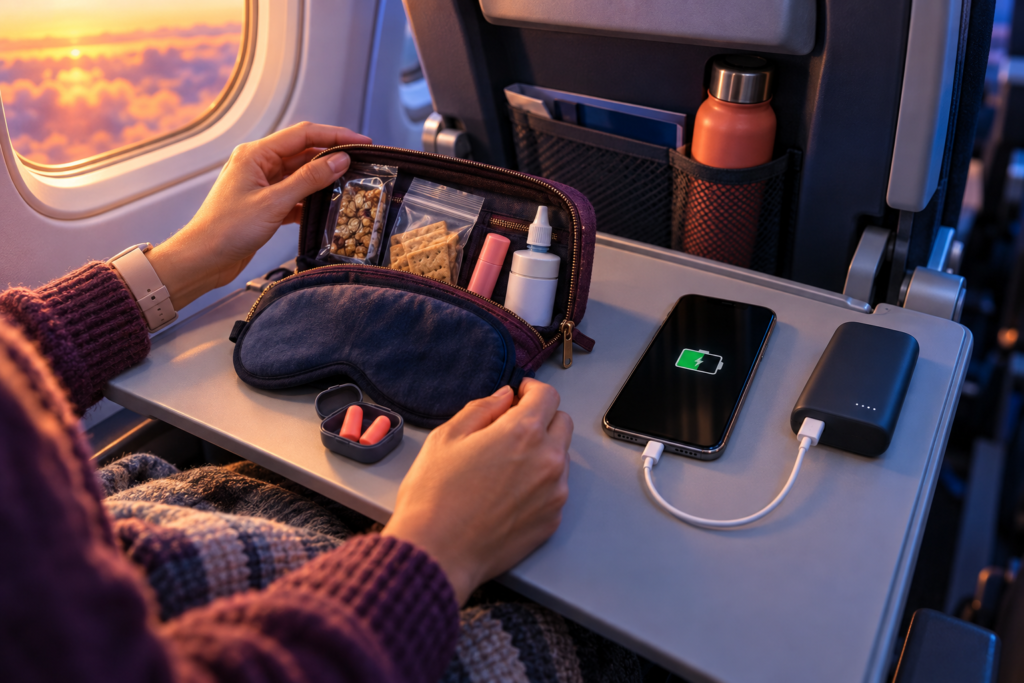
A compact power bank helps when the seat charging port doesn’t work, your seat doesn’t have one, or you’re spending extra time in an airport because travel plans have developed “character.” Keep it in an easy-to-reach pocket along with the correct charging cable for your device.
There’s an important airline safety rule here: power banks and spare lithium batteries must go in your carry-on baggage, not your checked suitcase. The Federal Aviation Administration says most rechargeable lithium-ion batteries up to 100 watt-hours are allowed in carry-on luggage; batteries from 101 to 160 watt-hours generally require airline approval, with a limit of two spare batteries. Check the watt-hour label and your airline’s current rules before you leave, and protect exposed terminals from short circuits. Never fly with a battery or device that is damaged, swollen, smoking, overheating, or subject to a safety recall. Review the FAA’s lithium battery guidance before packing.
This is one accessory where buying the biggest option isn’t automatically best. A smaller, clearly labeled power bank is often easier to pack and simpler to verify against airline rules.
5. An Empty Reusable Water Bottle
Cabin air is typically very dry, and the CDC notes that low humidity on flights can contribute to dry eyes and upper-airway dryness. A reusable water bottle gives you a simple way to keep water nearby after you’ve passed through security.
Bring it empty through screening, then fill it after security where a refill station or water fountain is available. Standard U.S. carry-on rules generally limit liquids, gels, aerosols, creams, and pastes to containers of 3.4 ounces, or 100 milliliters, or less, with those containers fitting inside one quart-size liquids bag.
A leakproof bottle with a secure lid is worth the small amount of bag space. You don’t need a giant jug that becomes awkward in a seat pocket. A modest-size bottle is usually easier to refill, carry around the airport, and tuck into your personal item.
If mobility is a concern or getting up during the flight is difficult, having water within reach can be particularly helpful. Flight attendants can provide water when service allows, but keeping your own bottle handy gives you more flexibility.
6. A Small Dry-Air Comfort Kit
A long flight can be rough on lips, hands, and eyes. A simple pouch with travel-size moisturizer, lip balm, and lubricating eye drops can make the cabin’s dry air feel less irritating.
The CDC notes that typical aircraft humidity can be around 10% to 20%, which may contribute to dry mucous membranes and eyes. This doesn’t mean everyone needs a full skincare routine at cruising altitude. It simply means a few familiar comfort items may earn their place in your personal bag.
Stick to TSA-compliant sizes for liquids, creams, and gels unless an item is medically necessary and declared during screening. A solid lip balm is especially easy to pack, while lotion and eye drops should be checked for size before you head to the airport.
If you have persistent eye symptoms, contact-lens concerns, or an existing eye condition, seek personalized guidance from an eye-care professional rather than experimenting mid-flight. For general context on aircraft cabin conditions, see the CDC’s air travel guidance.
7. A Medication Pouch That Stays With You
Essential medication belongs in your personal item or carry-on, not in checked luggage or a suitcase you’ll stow several rows away. A small zip pouch or compact organizer keeps it separate from snacks, cables, and the mysterious collection of receipts that seems to form inside every travel bag.
TSA permits medications in pill, liquid, and other forms, subject to screening. Medically necessary liquids and creams may be allowed in quantities larger than the usual 3.4-ounce limit, but you should declare them during screening.
A simple pouch works best when it holds only what you may need during the journey: regular medication, necessary dosing information, and an appropriate supply in case of delays. Keep labels and original packaging when practical, especially for international travel, where medication rules may differ by destination.
This is an essential-preparation item, not a glamorous travel purchase. But it can save you from the deeply inconvenient experience of realizing your medication is in the overhead bin after the seatbelt sign comes on.
8. A Neck Pillow That Fits Your Sleep Style
Neck pillows are very personal. One traveler swears by a wraparound memory-foam pillow; another finds it feels like wearing a flotation device indoors. There is no universal winner here.
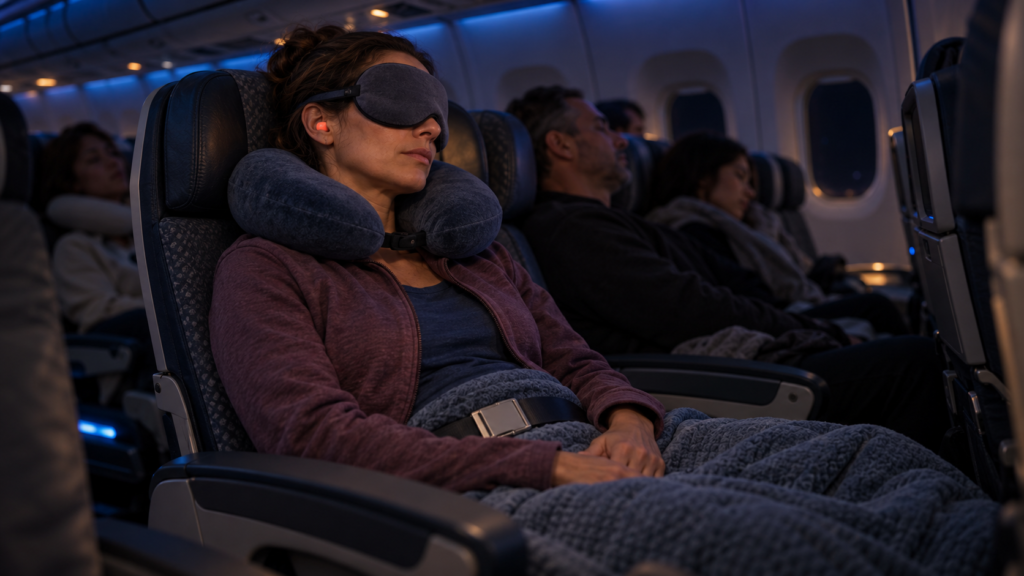
Still, if you tend to nod off and wake up with your head tilted at an alarming angle, a travel pillow may make resting in an upright seat more comfortable. The best shape depends on how you naturally sleep: against a window, straight back, leaning forward, or not at all because you’ve accepted that planes are not bedrooms.
Try it at home before committing it to a trip. Check whether it fits over headphones, works with the headrest, and can attach to your bag without becoming a bulky accessory that catches on every armrest in the terminal.
For travelers with neck pain, limited mobility, or a medical condition affecting posture, a standard travel pillow may not be suitable. Comfort is the goal, not forcing your body into a position it dislikes.
9. A Small Seat-Access Pouch for In-Flight Essentials
This accessory can be as simple as a zip pouch, slim sling bag, or small organizer that fits inside the personal item under the seat in front of you. Its job is to prevent the long-flight version of a scavenger hunt.
Keep your immediate essentials together: passport, phone, charging cable, headphones, eye mask, earplugs, lip balm, medication, and a snack if you’ve packed one. Once you’re seated, you can reach the pouch from your under-seat bag rather than repeatedly opening the overhead bin.
This is especially useful for families, travelers with limited mobility, or anyone seated in a middle or window seat. It can also make boarding less stressful because your larger carry-on can go overhead while the things you’ll actually use stay within reach.
You don’t need to buy a purpose-made travel organizer. A sturdy pouch you already own can do the job perfectly well. The real upgrade is deciding what needs to remain accessible before boarding begins.
Final Thoughts
The most useful long-flight accessories solve problems you can reasonably expect, not problems a glossy travel ad invented. Start with the essentials: accessible medication, water, power, and a way to manage light or noise if those things bother you.
After that, choose comfort upgrades based on your actual travel style. A frequent overnight flyer may love an eye mask and neck pillow, while someone taking a daytime flight may be happier with a charged phone, a water bottle, and less stuff to carry.