
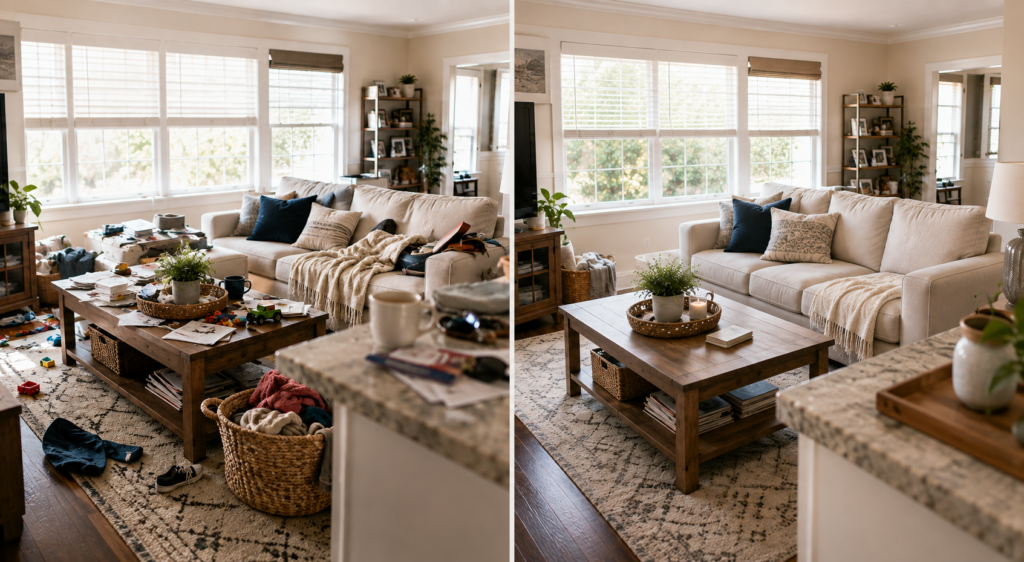
You cleaned the kitchen.
You vacuumed. You dusted. You wiped down the bathrooms. Maybe you even did that annoying little strip of floor between the refrigerator and the cabinets that nobody notices until something sticky lands there.
So why does the house still look cluttered?
What gives?
The problem may not be that your house isn’t clean. Clean and uncluttered aren’t the same thing.
You can have spotless countertops covered with appliances, a freshly dusted bookshelf packed with stuff, and a perfectly vacuumed living room containing seventeen things that don’t actually belong there.
If you’ve ever finished cleaning and wondered why your house somehow still looks messy, don’t start cleaning it all over again.
Look for these instead.
Affiliate disclosure: Some links in this article are affiliate links. If you make a purchase through an affiliate link, I may earn a commission at no additional cost to you. As an Amazon Associate I earn from qualifying purchases.
1. There’s Too Much Stuff Sitting on Your Flat Surfaces
Start here because this is one of the easiest things to spot.
Look at your:
- Kitchen counters
- Bathroom counters
- Coffee table
- Nightstands
- Dresser
- Dining table
- Entryway table
How much stuff lives there permanently?
A clean kitchen counter can still look cluttered when it’s holding a toaster, blender, knife block, coffee maker, utensil crock, paper towel holder, fruit bowl, vitamins, mail and three things somebody set down “for a minute” on Tuesday.
You don’t need bare counters.
But try removing a few things and see what happens.
The goal isn’t empty. It’s breathing room.
If you use the toaster every morning, leave it out. If you use the blender twice a month, maybe it doesn’t need prime kitchen real estate.
2. Your Everyday Stuff Doesn’t Have an Everyday Home
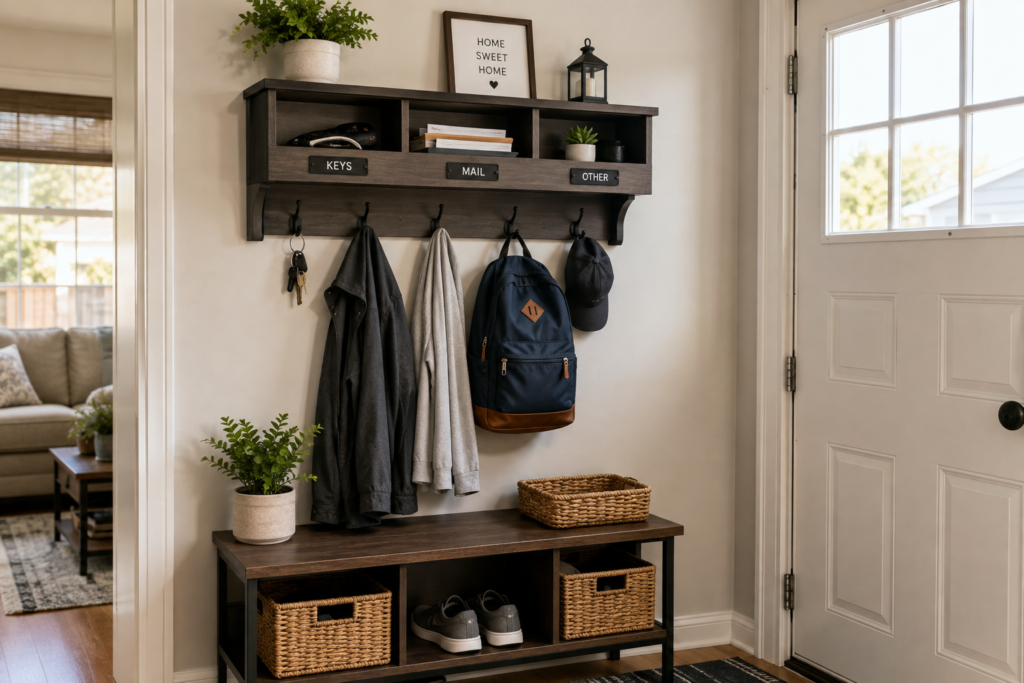
Key Holder Wall Mount, Wooden Key and Mail Organizer
This is the one that gets me.
Keys come in.
Mail comes in.
Shoes come off.
Sunglasses get tossed somewhere.
Chargers migrate around the house like they’re searching for a better life.
If the things you use every day don’t have an obvious place to go, they’re going to live on whatever horizontal surface happens to be nearby.
Instead of trying harder to “put things away,” make putting them away ridiculously easy.
Put a basket where shoes actually get kicked off.
Put hooks where bags actually land.
Put a small tray where keys actually get dropped.
Notice the important word there:
Actually.
Don’t build an organization system around where you think your family should put things.
Watch where everybody already puts them and work with that.
3. You Clean Around Clutter Instead of Removing It
I’ve done this.
Pick up pile.
Wipe counter.
Put pile back.
Ta-da! Clean pile. 😂
Cleaning removes dirt.
Decluttering removes things you don’t need, use, want, or have room for.
Sometimes you need both.
Before your next cleaning session, choose just one cluttered area—a bathroom drawer, kitchen counter, coffee table or one shelf—and deal with the stuff before you clean the surface.
Throw away trash.
Put wandering items where they belong.
Donate things you don’t use.
Then clean.
That one little area will probably look noticeably better than everything you merely dusted around.
4. Your Storage Is Full
Here’s a sneaky one.
Sometimes the problem isn’t that you need better baskets.
You don’t have anywhere left to put anything.
Open your cabinets and closets.
Are they packed?
Do you have to shove things aside to put something away?
Does putting away one clean towel require rearranging twelve other towels?
When your hidden storage is stuffed to capacity, everyday belongings start spilling into visible areas.
Before buying another organizer, ask whether the space actually needs less stuff.
A prettier container doesn’t magically create another closet.
5. You’ve Got Too Many Little Things Everywhere
A room can contain a reasonable amount of stuff and still look busy when everything is visually scattered.
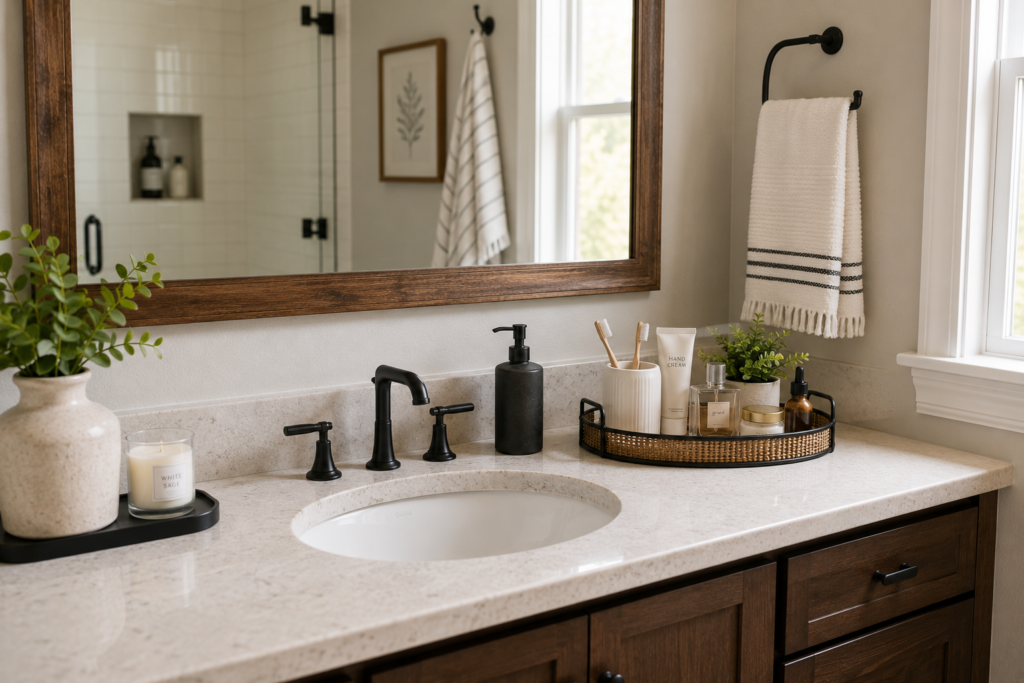
Five bottles lined up individually on the bathroom counter look like five separate things.
Put the same bottles together on a tray and your eye tends to read them as one little group.
Same amount of stuff.
Different visual effect.
Trays, baskets and containers can be especially useful for things you genuinely use and want accessible:
- Cooking oils beside the stove
- Toiletries on the bathroom counter
- Remotes on the coffee table
- Coffee supplies
- Kids’ art supplies
- Everyday skincare
But don’t use baskets to avoid making decisions.
A basket full of junk is still junk. It just has handles now.
6. Paper Is Quietly Taking Over Your House
Paper has an amazing ability to look harmless one sheet at a time.
Then suddenly there’s a pile.
Mail, school papers, receipts, coupons, forms, magazines, warranties, appointment reminders…
And because some of it might be important, nobody wants to throw anything away.
Give incoming paper a very short path:
Trash/recycle it. Act on it. File it.
That’s basically it.
A small inbox or tray can hold things that need attention, but give yourself a limit. When the tray is full, it’s time to deal with it.
Otherwise you’ve invented a decorative paper landfill.
7. You Own Too Many Duplicates
Go look under the kitchen sink.
I’ll wait. 😂
How many half-used cleaning products are in there?
Now try your bathroom cabinet.
Three nearly identical lotions? Five hair products you don’t use? Enough travel-size toiletries to open a tiny hotel?
Duplicates quietly consume storage.
Sometimes they’re useful. Having two sets of sheets isn’t exactly a hoarding crisis.
But if you’re constantly struggling for space, look for categories where you’ve accumulated far more than you realistically use.
Keep your favorites.
Use up what you can.
Stop buying the thing you apparently already own seven of.
8. Your “Just in Case” Stuff Has Taken Over
Some things are worth keeping just in case.
A basic tool kit? Absolutely.
Extra batteries? Sure.
The mysterious cable that belonged to an electronic device you haven’t owned since 2017?
We may be stretching the definition of emergency preparedness.
If letting things go is difficult, make a maybe box.
Put questionable items inside, write the date on it, and store it somewhere out of the way.
If months go by and you never need anything in the box, deciding what to do with it may be considerably easier.
You don’t have to become a minimalist.
You just need enough room for the things you actually use.
9. You’ve Filled Every Available Inch of the Room
This happens with decor as much as ordinary clutter.
Every wall doesn’t need something on it.
Every shelf doesn’t need to be full.
Every corner doesn’t need a basket, plant, chair, lamp or decorative ladder whose primary occupation is holding a blanket.
Leaving some open space gives your eyes somewhere to rest.
Try removing a few decorative items from a room—not permanently, just as an experiment.
Take a photo before and after.
You may be surprised by how much calmer the room feels when everything isn’t competing for attention.
10. The Clutter Keeps Coming Back to the Same Places
This may be the most useful clue of all.
If the kitchen island is messy every single evening, don’t just clear it again.
Ask why.
Are backpacks landing there because there’s nowhere near the door to put them?
Is mail piling up because nobody has decided what happens to it?
Are shoes collecting beside the sofa because the shoe storage is inconvenient?
Does clean laundry live on a chair because the closet is overcrowded?
Recurring clutter isn’t always a discipline problem.
Sometimes it’s a system problem.
The messy spot is telling you exactly where your current setup isn’t working.
Fix that, and you may stop cleaning the same pile over and over.
Before You Buy Another Organizer…
This deserves its own section because organization products are dangerous when you’re frustrated.
You see a beautiful row of matching containers and think:
THAT’S IT. Those bins will finally fix my life.
Maybe.
But first decide:
- What exactly needs to be stored?
- Do I actually need to keep all of it?
- Where would using this item be most convenient?
- What size storage do I actually need?
- Will everyone in the house realistically use this system?
Declutter first. Organize second. Shop third.
Otherwise you may simply spend $87 to make your clutter coordinate.
Try the 10-Minute Clutter Test
If your house is clean but still looks messy, don’t tackle the whole thing.
Set a timer for ten minutes.
Choose the room bothering you most and remove only visual clutter.
Don’t vacuum.
Don’t dust.
Don’t scrub anything.
Clear things that don’t belong. Reduce crowded surfaces. Group the things that stay. Put obvious wandering objects away.
Then stop and look at the room.
If it suddenly looks considerably cleaner even though you didn’t technically clean anything…
You’ve found the problem.
Final Thoughts
If your house still looks cluttered after you clean it, that doesn’t necessarily mean you need to clean more.
You may need less stuff on the counters.
A better landing spot for everyday things.
Some breathing room on your shelves.
Less paper.
Less “just in case.”
Or simply a storage system designed around how your household actually behaves.
Start with the clutter spot that annoys you the most and figure out why it keeps happening.
You don’t need a perfectly organized house.
You need a house where putting things away isn’t harder than leaving them out.
And if you discover you’ve been carefully dusting the same pile of clutter every Saturday…
At least now you can stop polishing it. 😂