
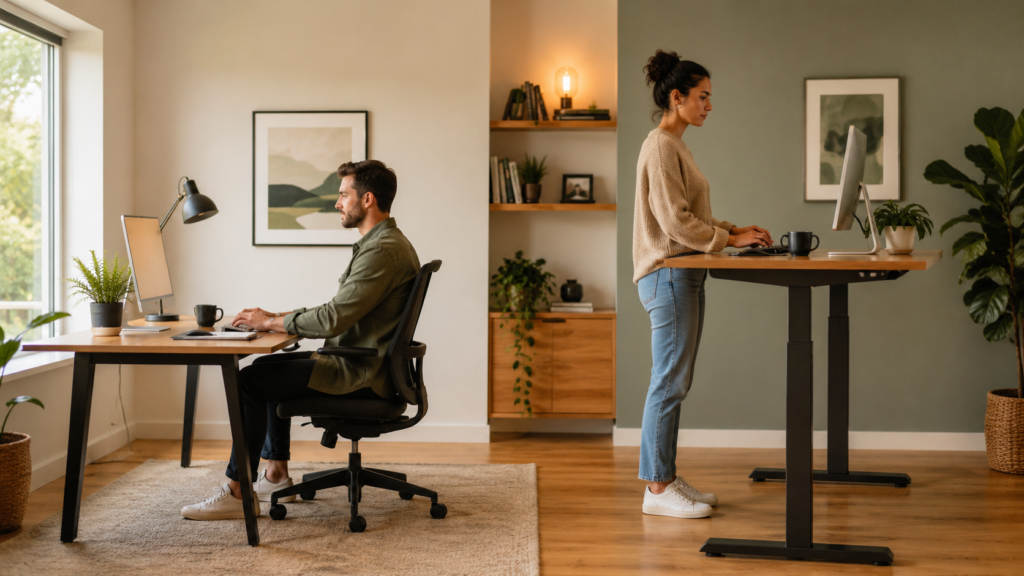
When comparing a standing desk vs. traditional desk, the right choice comes down to more than whether you prefer sitting or standing. Your available space, work routine, equipment, budget, and willingness to adjust your setup all matter. A desk is one of those everyday items that can quietly make a room easier to use—or become the place where cables, paperwork, and mystery mugs gather.
Adjustable standing desks let you change your work height, while traditional desks provide a fixed surface designed mainly for seated use. Neither is automatically better. The right desk is the one that fits how you actually work, study, create, plan meals, pay bills, or occasionally open your laptop while pretending you are not also watching a recipe video.
Comparison Overview
Standing desks and traditional desks serve the same basic purpose: giving you a dedicated work surface. The main difference is flexibility. Most standing desks can be raised or lowered to support different working positions, while a traditional desk stays at one fixed height.
For many households, the decision also affects the surrounding room. An electric standing desk needs access to power, and any adjustable model requires enough clearance to move upward safely. A traditional desk is often simpler to place, especially in a small office, bedroom, kitchen corner, or multipurpose room where furniture needs to stay put.
Side-by-Side Comparison
| Criteria | Standing Desk | Traditional Desk |
|---|---|---|
| Work position | Supports sitting and standing when adjustable | Primarily supports seated work |
| Height adjustment | May use manual or electric adjustment | Fixed height |
| Setup complexity | Can require assembly, power access, and cable planning | Usually has a simpler setup |
| Moving parts | Adjustable models include mechanisms that may need occasional attention | Typically has fewer moving parts |
| Space needs | Requires overhead and surrounding clearance when raised | Needs a consistent footprint |
| Desk accessories | May benefit from monitor arms, cable management, or adjustable accessories at different heights | Works easily with standard seated office accessories |
| Budget range | Adjustable mechanisms can increase the cost | Basic fixed desks are often the simpler, lower-cost option |
| Best fit | People who want position flexibility during the day | People who prefer a straightforward, stable seated setup |
Key Differences
Adjustability Versus Simplicity
The central difference is obvious but important: adjustable standing desks can change height, while traditional desks cannot. That flexibility is useful if your day includes long stretches of computer work and you want to switch positions without leaving your workspace.
A traditional desk keeps things refreshingly uncomplicated. There is no control panel, crank, lifting column, or question about whether the desktop is high enough for your monitor setup. If you are comfortable working seated and do not need regular height changes, fixed furniture may be all you need.
Room Layout and Clearance
A standing desk needs room to travel upward. That sounds simple until you place it beneath shelves, wall cabinets, a window ledge, or a low ceiling feature. In a compact apartment or kitchen-adjacent workspace, measure the intended location carefully before choosing an adjustable model.
Traditional desks are easier to plan around because their height never changes. They can fit neatly under wall shelves or into a built-in nook without causing a surprise collision later. That predictability is especially helpful in shared rooms where every inch has a job.
Stability at Different Heights
A well-designed standing desk should provide a stable work surface throughout its intended height range, but wobble can become more noticeable when the desktop is raised. A tall monitor, heavy desktop computer, uneven floor, or less-rigid frame can all affect how steady the setup feels.
Traditional desks have the advantage of a fixed, lower work surface. That does not mean every fixed desk is rock-solid—construction and assembly still matter—but there are fewer variables once it is in place. For detailed tasks such as drawing, writing, gaming, or working with small tools, that consistency may be appealing.
Accessories and Ergonomic Fit
Changing the desk height also changes how your accessories are positioned. Your monitor, keyboard, mouse, laptop stand, and task light should remain comfortable to use whether you are seated or standing. Monitor arms and adjustable keyboard trays can make the transition smoother, though they are not essential for every setup.
With a traditional desk, you can arrange one seated workstation and leave it alone. A supportive chair and sensible monitor placement still matter, but you do not have to make the same workstation suit two different heights. Less adjusting can be a real benefit if you value a tidy, low-fuss setup.
Mechanical Features and Long-Term Considerations
Standing desks with lifting mechanisms offer more flexibility but also include more components. Electric models need a nearby outlet and add cords to manage. Manual models avoid the power requirement but may take more effort to adjust. Neither approach is inherently troublesome, but both are worth considering before you buy.
Traditional desks generally rely on straightforward construction: legs, a frame, a desktop, drawers, and perhaps a cable opening. Fewer mechanical components can make them easier to understand, assemble, and maintain over time. Sometimes boring furniture is exactly what you want. Boring furniture rarely asks for troubleshooting.
Performance and Everyday Use
Switching Positions During a Workday
A standing desk is useful when you want to alternate between seated and standing work. That does not mean you need to stand all day, and it does not require turning every email into a fitness event. The practical benefit is choice: you can raise the surface for part of the day, then lower it when you want to sit.
A traditional desk is better suited to a mostly seated routine. It provides a consistent setup without interruption, which can work well for focused computer tasks, handwriting, online classes, or projects that require you to remain in one position for a while.
Managing Technology and Cables
Standing desks require more cable planning because monitor, charger, lamp, and computer cords need enough slack to move safely with the surface. Cable trays, clips, and mounted power strips can keep cords from dangling or catching, but they add another step to the setup process.
Traditional desks simplify cable management because the equipment remains at the same height. If your workspace includes a printer, external drives, speakers, or other connected equipment, a fixed desk can make it easier to keep everything connected and contained.
Working in Small or Shared Spaces
In a dedicated office, a standing desk may be easy to accommodate. In a shared bedroom, dining room, or compact kitchen-adjacent corner, its changing height can be less convenient. The desk needs clear space above it, along with enough room for a chair when the surface is lowered.
Traditional desks work well in rooms that pull double duty. Their fixed profile can sit beneath shelves, beside a dining table, or against a wall without changing the layout each time someone uses the space. If your desk needs to blend into daily household life rather than dominate it, that can be a meaningful advantage.
Durability and Maintenance
Standing desks benefit from occasional basic care. Keep the lifting area clear, stay within the manufacturer’s stated weight capacity, check that fasteners remain secure, and arrange cables so they do not snag during height changes. With electric models, the power connection and control system are also part of long-term ownership. A desk mat or coasters can help protect the desktop from drink rings, scratches, and the inevitable drip from a rushed lunch at the keyboard.
Traditional desks usually need simpler maintenance, such as dusting, wiping up spills promptly, tightening hardware, and caring for the desktop according to its finish. Drawers and hinges may eventually need adjustment, but fixed desks generally have fewer parts to inspect. If easy repairs and minimal upkeep are priorities, a sturdy traditional desk can be the more straightforward long-term choice.
Cost and Overall Value
Standing desks can cost more because adjustable frames and lifting systems add complexity. Paying more may make sense if you expect to use the height adjustment regularly or need the desk to support a larger monitor setup or multiple work tools. The value comes from using that flexibility, not simply owning a desk that goes up and down.
A traditional desk may offer better value when you need a dependable surface for seated work and do not expect to change positions often. The money saved can go toward a comfortable chair, useful lighting, storage, or cable management—items that can improve a workspace just as much as a more elaborate desk frame. A less expensive desk may be all you need if it fits your room, supports your equipment, and feels stable.
Who Should Choose Each Option
The Person Who Wants More Position Flexibility
A standing desk is likely the better fit if you want to change your work position throughout the day. It can suit remote work, study sessions, creative projects, and household administration when you do not want to remain seated for every task. Just make sure you have room for the desk to rise, along with a plan for cords and accessories.
The Seated Worker With a Stable Routine
A traditional desk is a strong choice if you do most of your work while sitting and prefer a set-it-and-forget-it arrangement. It can be especially practical if you use a desktop computer, write by hand, game, sew, or complete detailed work that benefits from a stable surface at one familiar height.
The Small-Space Household
A traditional desk may fit better in a small home office, bedroom, kitchen corner, or shared living area. Its fixed dimensions make room planning easier, and it can often sit beneath shelves or cabinets that would limit a standing desk’s movement.
The Dedicated Home Office User
A standing desk can make sense in a dedicated office where you have enough clearance, power access, and space for a chair and other equipment. If the room is built around work rather than shared with meals, guests, or storage, it is easier to take full advantage of an adjustable setup.
The Budget-Conscious Buyer
A traditional desk is often the more sensible starting point when your budget is limited. Look for a stable design with enough surface area and storage for your actual needs. Height adjustment is useful, but it is not essential for every workspace.
Final Verdict
Standing desks are best for people who value the ability to move between sitting and standing and have enough space for an adjustable workstation. They require more planning around cables, clearance, accessories, and possible mechanical upkeep, but that flexibility can be worthwhile when it matches your daily routine.
Traditional desks remain an excellent choice for seated work, smaller rooms, stable setups, and simpler budgets. Choose a standing desk if adjustable height is a feature you will genuinely use. Choose a traditional desk if consistency, simplicity, and easy placement matter more.
Ultimately, the standing desk vs. traditional desk decision depends on how you work, how much room you have, and whether you will genuinely use the adjustable height.
Frequently Asked Questions
Is a standing desk better than a traditional desk?
Not universally. A standing desk is better if you want adjustable working positions, while a traditional desk is better if you prefer a simple, stable setup for seated work.
Do standing desks require electricity?
Some do. Electric standing desks need power, while manual models may use a crank, lever, or other non-electric adjustment method.
Can you use a regular chair with a standing desk?
Yes, provided the desk can be lowered to a suitable seated height. An adjustable chair can make it easier to create a comfortable seated setup.
Are traditional desks easier to maintain?
Generally, yes. They usually have fewer moving parts, so routine care often involves cleaning the surface and occasionally tightening the hardware.
How much space does a standing desk need?
It needs enough floor space for the desk and chair, plus clear vertical space above the desktop when raised. Measure around shelves, cabinets, windows, and wall décor before choosing one.