
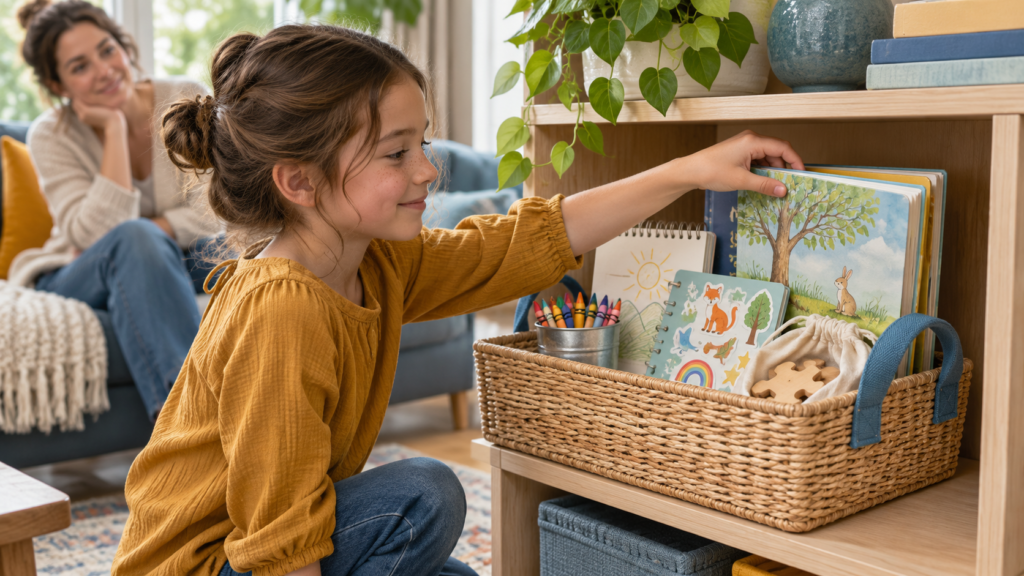
An “I’m bored” activity basket gives your kids a simple place to look when they need something to do and you need a break from being the household cruise director. The goal isn’t to create a magical bin that entertains everyone forever. It’s to offer a small, familiar selection of activities your child can choose from and use within the limits you set.
A good activity basket removes a few tiny hurdles: deciding what to do, finding the supplies, and asking where everything is. It can live in a living room, play area, bedroom, or even a small apartment corner—as long as it’s easy to reach and easy to put away.
Quick Overview
You’ll learn how to create an “I’m bored” activity basket that works for your home and suits your child. The basket should hold a limited rotation of familiar, pre-approved activities rather than every toy your child owns.
It works best when each item matches your child’s abilities and the manufacturer’s age and safety guidance. “Independent” means choosing and using familiar activities within caregiver-set limits—not playing without appropriate supervision.
What You’ll Need
- An open basket, sturdy tote, or low-sided bin that your child can access easily
- A small selection of age-appropriate activities your child already knows how to use
- Optional smaller containers, zippered pouches, or envelopes that your child can safely manage
- Labels, picture labels, or masking tape if they would help your child identify where items belong
- A nearby place to return activities after use, such as a shelf or cubby
- A few minutes for regular basket checks and resets
Before You Begin
Start by thinking about the function of the basket in your home. Is it for quiet play while you make dinner nearby? A rainy-day option in the living room? Something to use while a sibling is doing homework? One clear purpose will help you avoid turning the basket into a random pile of toys with nowhere to go.
Next, consider the child who will use it. The Consumer Product Safety Commission advises choosing toys based on a child’s interests and abilities, along with the package age guidance. Two children of the same age may handle the same activity very differently, so follow the label and consider whether your child needs additional limits or help.
Do a quick safety review before stocking the basket. For children under 3, leave out small parts, marbles, small balls, and tiny beads. The CPSC specifically advises keeping toys with small parts and small balls away from children younger than 3. Skip water beads altogether; the CPSC warns against allowing children to play with them because they can expand after being swallowed. Also leave out loose magnets and remove magnetic toys with missing or dislodged magnets.
Step-by-Step Instructions
Step 1: Choose a basket that fits the space and your child
Pick an open container that is easy for your child to see into. If your child will move it, keep it light enough for them to manage. A simple woven basket, fabric bin, or shallow plastic tub can work. You do not need a matching set of expensive storage containers for this to be useful.
For small homes, choose a basket that fits on one shelf, under a coffee table, or beside a reading chair. An open basket lets your child see what is available without dumping everything out to investigate. Make sure the container itself has no sharp edges, cracks, loose handles, or splinters.
Step 2: Set a simple purpose and a few household limits
Decide when and where the basket can be used. For example, it might be available during quiet play in the family room, while you fold laundry nearby, or after school before dinner. A clear routine helps the basket stay useful instead of becoming another source of clutter.
You can also set limits that fit your home. Maybe activities stay on a tray, at the kitchen table, or on a designated rug. Perhaps one activity goes away before another is chosen. These aren’t strict rules for the sake of rules; they make cleanup more realistic and help prevent every tiny piece from migrating beneath the sofa.
Step 3: Gather only activities your child already understands
The best activity basket items require little to no adult setup. Include things your child has used before and can reasonably put away with some guidance. A brand-new, complicated craft kit may be exciting, but it belongs elsewhere if it requires your help with tools, instructions, or a scavenger hunt for missing supplies.
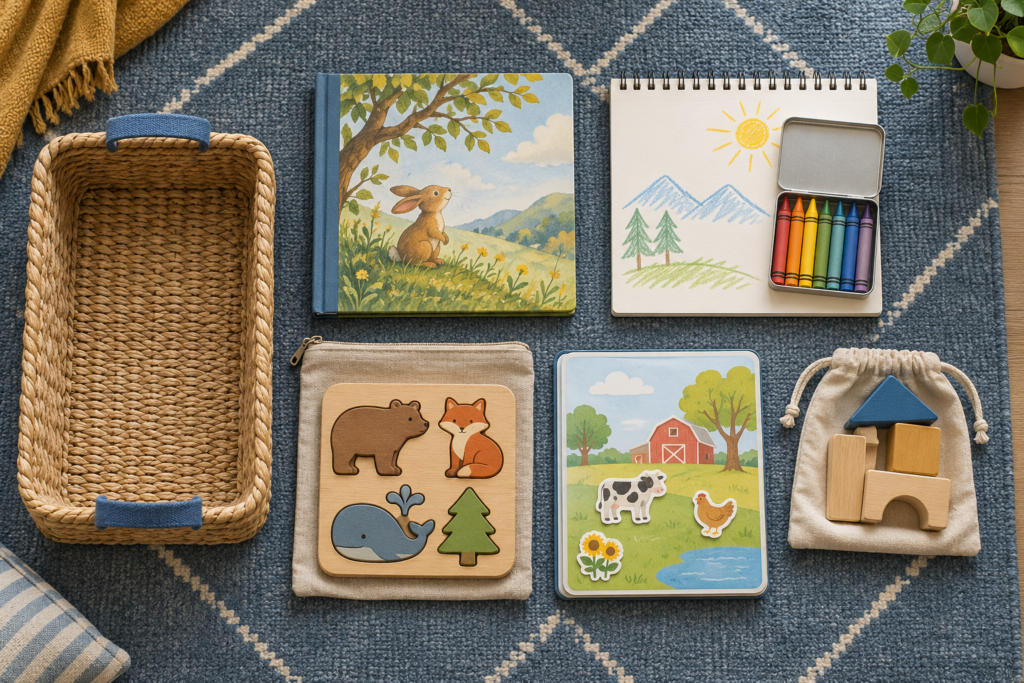
Depending on your child’s age, abilities, and product labeling, ideas may include:
- Picture books or simple chapter books
- Coloring books and a small set of crayons or colored pencils
- Reusable sticker books designed for your child’s age
- Age-appropriate puzzles with all pieces accounted for
- Large building pieces or interlocking blocks
- Pretend-play items, such as toy animals or dolls
- A familiar card game or matching game your child can use on their own
- A sketchpad or activity book
- Age-appropriate lacing cards or larger-piece sorting activities
Try starting with four to six options rather than packing the basket to the rim. Too many choices can turn “I’m bored” into “I dumped out seventeen things and now I’m somehow more bored.”
An easy starter basket for an elementary-age child: Try a favorite book, a sketchpad with crayons, a familiar puzzle, a reusable sticker book, and a small set of building pieces appropriate for your child. Keep each activity together so choosing something doesn’t turn into another request for help. Start with supplies you already own, then adjust based on what actually gets used.
Step 4: Check every item for age guidance and condition
Before adding an activity, check its age label, condition, and instructions. Leave out anything broken, anything with unsecured batteries or loose magnets, and anything that needs more help or supervision than you can provide. For the simplest starting point, stick with books, paper activities, and sturdy non-electronic toys.
Consider younger siblings, too. An activity that suits your older child may need to stay somewhere a toddler cannot reach.
Step 5: Keep loose pieces contained and easy to reset
Activities with several pieces can still work well when everything has a home. Put puzzle pieces in a zippered pouch, store cards in a small box, or use an envelope for paper dolls and their accessories. Choose containers your child can open and close safely.
If your child is not ready to manage loose pieces, choose activities with fewer parts or save those games for a separate, adult-led time. It is perfectly fine if the basket is mostly books, crayons, and a few sturdy toys. The point is usefulness, not variety for variety’s sake.
Step 6: Show your child how the basket works
Introduce the basket at a calm time rather than during a full-volume boredom emergency. Walk through the choices together, explain where it can be used, and demonstrate how each item returns to the basket or its pouch.
Keep the explanation light: “When you want something to do, you can pick one thing from this basket. When you’re finished, it goes back before you choose something else.” If cleanup is still beyond your child’s current ability, make the return routine a shared task. Expect to practice together rather than explain everything once and call it done.
Step 7: Put the basket where it can actually be used
Place the basket in the room where your child most often has unstructured time and where you can provide appropriate oversight. A beautiful basket tucked into an inaccessible closet may look organized, but it will not solve the “what can I do?” problem at 4:45 on a Tuesday.
For shared spaces, choose a location that does not block walkways or create a tripping hazard. If space is tight, you may prefer a lightweight bin that you bring out during playtime and put away afterward. A basket does not need a permanent playroom address to be useful.
Step 8: Rotate and inspect the basket regularly
After use, do a quick check for broken items, loose parts, damaged magnetic toys, or battery compartments that no longer close securely. Remove anything your child has started using in an unsafe way.
Every so often, clear out completed coloring pages, incomplete puzzles, and activities your child no longer chooses. Add one or two different options from a nearby shelf or closet rather than buying something new each time interest fades.
A quick reset keeps the basket ready for next time, with complete puzzles, usable crayons, and activities your child still enjoys.
Helpful Tips
- Make a separate basket for each child when siblings have very different ages or safety needs. Keep older children’s small-piece activities out of younger siblings’ reach, not just in a different basket.
- Use picture labels for younger children or children who are not yet reading. A photo of the puzzle or crayons can make cleanup more straightforward.
- Keep art supplies modest. A small crayon box is easier to manage than a full craft cabinet in miniature.
- Choose washable or easy-to-clean items for busy family spaces, while still following age and safety guidance.
- Store refill supplies elsewhere. The basket does not need every coloring book, every block, and every sticker sheet at once.
- If an activity consistently leads to frustration, conflict, or unsafe use, remove it without treating the basket as a failure. It is simply useful information about what belongs there right now.
Common Mistakes to Avoid
- Overfilling the basket. Too many items make it harder to find things and clean up. Start small and rotate options.
- Adding activities that require adult setup. If your child cannot open, understand, or use an activity without immediate help, save it for another time.
- Using one generic basket for children with different needs. Match contents to the individual child, especially when younger siblings are nearby.
- Including tiny loose pieces for young children. Follow age labels and avoid small parts, marbles, tiny beads, and small balls for children under 3.
- Using water beads as sensory filler. Do not add them to an activity basket; the CPSC advises keeping water beads away from children.
- Forgetting maintenance. Broken items, dried-out markers, and incomplete games make the basket less appealing, and damaged toys can create safety concerns.
- Expecting the basket to solve every bored moment. It is one helpful household tool, not a promise that every child will be entertained on demand.
Final Thoughts
An “I’m bored” activity basket works best when it is simple enough to use on an ordinary day. Start with what your child already enjoys, keep safety and cleanup in view, and adjust the contents as your child’s needs change.
There is no prize for creating the most aesthetic basket on the internet. A slightly scuffed bin holding a few well-loved, usable activities is doing exactly what it needs to do.
Frequently Asked Questions
What age is an “I’m bored” activity basket best for?
You can adapt a basket for many ages, but tailor the contents to your child’s abilities, interests, and the manufacturer’s age guidance. Younger children generally need simpler choices and closer adult oversight. The basket does not replace supervision.
How many activities should I put in the basket?
Start with a small selection, such as four to six activities. Adjust that number if your child has trouble sorting through the choices or putting them away.
Can I include snacks in an activity basket?
Keep snacks separate from toys, books, and art supplies. If your child wants a snack, serve it separately with supervision appropriate to their age and needs.
What should I do if my child loses interest in the basket?
Rotate a few items instead of adding more and more things. Remove activities that are broken, too difficult, or no longer appealing, then bring back a familiar item after it has been stored away for a while.