
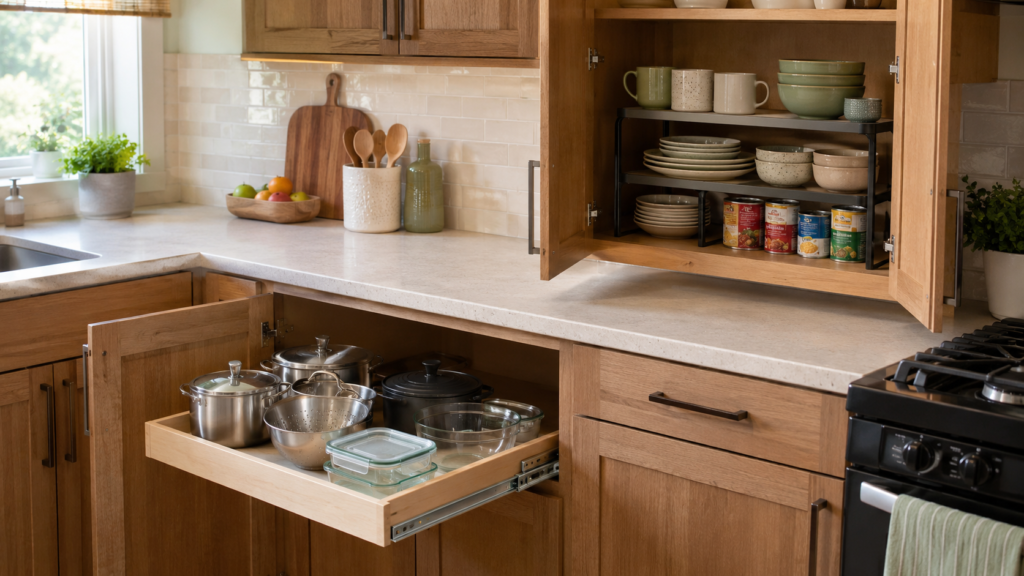
Small kitchens rarely lack shelves; they lack reachable shelves. That’s why pull-out cabinet shelves and shelf risers are so often compared. Both can make a cramped cabinet more useful, but they solve different problems: one improves access to items in the back, while the other creates an extra level for things that would otherwise form a slightly alarming stack.
The better choice depends on what you store, how often you cook, and whether you’re ready to modify your cabinets. Pull-out shelves can turn deep lower cabinets into accessible storage, while shelf risers offer a simpler way to divide vertical space in upper cabinets, pantries, and even on counters. Neither is magic, sadly. But either can stop the “Where did that pan go?” routine.
Affiliate disclosure: Some links in this article are affiliate links. If you make a purchase through an affiliate link, I may earn a commission at no additional cost to you. As an Amazon Associate I earn from qualifying purchases.
Comparison Overview
Pull-out cabinet shelves are trays or shelves installed inside a cabinet that slide forward on hardware. They are most useful in deep cabinets where canned goods, cookware, small appliances, or food containers tend to disappear behind whatever is in front. By bringing the contents toward you, they reduce reaching, kneeling, and unloading half the cabinet just to find one ingredient.
Shelf risers are freestanding platforms that sit on an existing shelf and create a second tier. They work best for shorter items such as mugs, bowls, plates, canned food, spices, snack boxes, and food-storage containers. They don’t pull anything closer, but they can prevent wasted air space above a short stack of dishes or pantry staples.
Side-by-Side Comparison
| Criteria | Pull-Out Cabinet Shelves | Shelf Risers |
|---|---|---|
| Main purpose | Improves access to items stored deep inside cabinets | Creates an additional level of vertical storage |
| Best cabinet location | Deep lower cabinets, pantry cabinets, and hard-to-reach shelves | Upper cabinets, shallow pantry shelves, and open shelving |
| Installation | Usually requires measuring and mounting hardware | Generally sits directly on an existing shelf |
| Accessibility | Brings stored items forward for easier viewing and retrieval | Makes stacked items easier to separate, but items in the back may still be hard to reach |
| Storage strengths | Pots, pans, small appliances, dry goods, containers, and heavier everyday items when properly supported | Mugs, dishes, canned goods, snack items, spices, and shorter containers |
| Flexibility | More permanent once installed, though some systems can be adjusted or removed | Easy to move, reposition, or reuse in another cabinet |
| Impact on shelf height | Uses some vertical clearance for the shelf and sliding hardware | Requires enough room above and below the riser to make both levels practical |
| Cleanup considerations | Crumbs and spills can collect in the tray and around slide hardware | Easy to lift out and wipe down along with the cabinet shelf |
Key Differences
Access Versus Extra Vertical Space
The biggest difference is simple: pull-out shelves improve access, while shelf risers improve vertical organization. A pull-out shelf is especially helpful when your cabinet is deep enough for items to migrate toward the back and establish a new life there. Instead of reaching over front-row cookware, you slide the contents toward you.
A shelf riser does not fix a deep-cabinet problem. It can make the front portion of a cabinet more organized, but it won’t bring that forgotten bag of rice forward. Its strength is preventing short items from sitting beneath a large pocket of unused space.
Installation Commitment
Shelf risers are the low-commitment option. Most require no drilling, hardware, or cabinet modifications. You measure your shelf, choose a riser that fits, place it inside, and reorganize. If your mugs turn out to be too tall or your cabinet isn’t as roomy as it looked in your imagination, you can move the riser elsewhere.
Pull-out cabinet shelves demand more planning. You’ll need accurate interior cabinet measurements, including width, depth, door clearance, hinges, and any obstructions. Some installations may be manageable as a DIY project, while others may be better handled by a cabinet professional. The prep matters because a poorly fitted pull-out shelf is just an expensive drawer that refuses to cooperate.
What They Can Store Well
Pull-out shelves suit a wide range of kitchen storage needs. They can make everyday cookware, baking dishes, mixing bowls, dry goods, and food containers easier to access. In lower cabinets, they can be particularly useful for heavier items that are awkward to retrieve from a low, deep shelf.
Shelf risers are better for lighter, stackable, or easily visible items. Think drinking glasses, bowls, canned tomatoes, tea boxes, lunch containers, or rows of spices. They are not always ideal for large pots, tall bottles, or bulky appliances because those items can make the levels feel cramped or unstable.
Space Efficiency Depends on the Cabinet
A riser may create more usable space in an upper cabinet that holds mugs or dishes because it divides open vertical space into two practical levels. If the shelf is tall enough, one riser can make room for two neat rows where there was previously one short stack and a lot of empty air.
In a deep lower cabinet, however, a pull-out shelf may create more usable space even if it does not add another level. A cabinet packed from front to back is not particularly helpful if you can reach only the first few items without crouching and excavating. Pull-outs make the cabinet’s full depth easier to use.
Cabinet Compatibility and Clearance
Shelf risers require enough height to work. A riser that technically fits but leaves only an inch or two above the lower level won’t help much. Before choosing one, measure the cabinet’s interior height and the items you plan to store.
Expandable adjustable stackable kitchen cabinet organizer
Pull-out shelves require different kinds of clearance. The cabinet needs enough interior width and depth for the shelf and its sliding mechanism, and the door must open wide enough for the shelf to extend. Face-frame cabinets, exposed hinges, plumbing, and fixed shelf supports can all affect compatibility. Measuring first is not glamorous, but neither is returning a storage solution that almost fits.
Performance and Everyday Use
Daily Cooking and Meal Prep
If you cook often, pull-out cabinet shelves can make daily kitchen work smoother. Keeping mixing bowls, pans, food containers, or dry ingredients on pull-outs means less reaching and rearranging before dinner. They are particularly useful when you use the same cabinet items several times a week.
Shelf risers work well for frequently grabbed pantry items and dishes. A riser can give breakfast bowls their own level, keep lunch containers from collapsing into a plastic avalanche, or make canned goods easier to scan. They are less useful in a cabinet full of large cookware, where the riser may simply get in the way.
Deep Cabinets and Low Storage
Deep, low cabinets are where pull-out shelves shine. Fixed shelves often force you to choose between storing items in front, where they’re accessible, or using the full depth and accepting that the back section may become a mystery zone. Pull-outs reduce that trade-off.
Expandable Pull Out Cabinet Organizer
Shelf risers can still help in lower cabinets, but only in certain situations. They may work for lightweight pantry goods or short containers if there is enough vertical room. They are usually less practical for heavy Dutch ovens, stacks of pans, or oversized serving pieces that need stable, open storage.
Upper Cabinets and Pantry Shelves
Upper cabinets often favor shelf risers because vertical space is commonly the issue. If one shelf holds short glasses, mugs, or small bowls with a large gap above them, a riser can help the cabinet hold more without making it feel overstuffed.
Pull-out shelves can work in pantry cabinets and some upper cabinets, especially when the shelves are deep. Still, their installation and added structure may not be necessary for a shallow cabinet. In that situation, a riser can provide a quicker, less involved improvement.
Flexibility for Changing Kitchens
Shelf risers are easy to adapt as your kitchen changes. You can move them from a dish cabinet to a pantry shelf or repurpose them outside the kitchen. This flexibility is useful for renters, temporary living arrangements, or anyone still figuring out how their kitchen works.
Pull-out shelves are more of a long-term organizational decision. They can be worthwhile when a cabinet has a clear, ongoing job, such as holding cookware or pantry staples. But if you frequently change cabinet layouts or expect to move soon, a removable riser may make more sense.
Durability and Maintenance
Pull-out cabinet shelves have more components to maintain. The shelf surface should be wiped regularly, especially if it holds dry goods, baking supplies, or containers that may leak. Sliding hardware can collect dust and crumbs over time, so it should stay clear of loose debris to keep the shelf moving smoothly. If a track, mounting point, or drawer mechanism becomes damaged, repairs may require replacement parts or more involved cabinet work.
Shelf risers are generally simpler to maintain because they have no moving parts. Most can be removed, wiped clean, and returned to the cabinet in minutes. Their long-term durability depends on the material, construction, and weight placed on them. Avoid overloading a riser or using it to support items that feel unsteady, particularly glassware or tall stacks of dishes. A simple organizer is helpful only until it becomes a tiny elevated hazard.
Cost and Overall Value
Shelf risers are often the better value when your main issue is wasted vertical space. They require little installation effort and can be moved if your needs change. For a cabinet of mugs, canned goods, or small dishes, a basic riser may solve the problem without turning it into a larger storage project.
Pull-out shelves can justify a higher investment when access is the bigger frustration. If you regularly struggle to reach cookware, pantry goods, or containers in the back of deep cabinets, better access may be more valuable than adding another shelf level. Their value increases when they improve a cabinet you use every day, not one reserved for the once-a-year roasting pan.
Who Should Choose Each Option
The Renter or Low-Commitment Organizer
Shelf risers are usually the better fit if you rent, want to avoid cabinet modifications, or need a solution you can move later. They provide a noticeable storage improvement without permanent installation and can be repositioned as your kitchen setup evolves.
The Frequent Home Cook With Deep Lower Cabinets
Pull-out cabinet shelves are likely the better choice if you cook often and keep pans, bowls, ingredients, or containers in deep lower cabinets. They make those items easier to reach and can reduce the repeated reaching and shifting that fixed shelves tend to require.
The Small-Pantry Household
Shelf risers work well for a small pantry filled with short packaged foods, canned goods, snacks, tea, and jars. They can help you use open vertical space while keeping labels visible. Just avoid creating crowded levels that make items difficult to remove safely.
The Cookware Collector
Pull-out shelves are generally more useful for cookware, bakeware, and heavier kitchen tools, provided the cabinet and hardware are designed to support the load. A riser may help separate lids or small pans in some cases, but it is rarely the most practical answer for a cabinet packed with bulky pieces.
The Upper-Cabinet Space Maximizer
Shelf risers are usually the more sensible option for upper cabinets holding mugs, glasses, bowls, or plates. They can turn a single tall shelf into two accessible zones without requiring a more complex overhead installation.
Final Verdict
Pull-out cabinet shelves and shelf risers create usable space in different ways. Pull-outs make deep storage easier to reach, which can be a major improvement in lower cabinets and heavily used pantries. Shelf risers add vertical levels, making them especially helpful in upper cabinets and for collections of shorter kitchen items.
Choose pull-out cabinet shelves when accessibility is the real problem: items are buried, cabinets are deep, and everyday cooking involves too much reaching or rearranging. Choose shelf risers when you have unused vertical room and want a simple, flexible way to organize lighter items. The best small-kitchen upgrade is the one that fixes the frustration you actually have, not the one that merely looks organized for five minutes.
Frequently Asked Questions
Do pull-out shelves create more space than shelf risers?
Pull-out shelves usually create more usable space in deep cabinets because they make the back area accessible. Shelf risers may create more vertical storage capacity when there is unused height above shorter items.
Are shelf risers safe for dishes and glassware?
They can be, as long as the riser is stable, placed on a level shelf, and not overloaded. Store heavier items on the lower level when possible, and avoid stacking glassware where it could be easily knocked over.
Can pull-out shelves be installed in any cabinet?
Not always. Cabinet width, depth, door clearance, hinges, interior frames, plumbing, and fixed shelves can affect whether a pull-out system will fit and operate properly.
Are shelf risers useful in lower cabinets?
They can be useful for lightweight pantry goods or containers, but they are often less effective in deep lower cabinets or for heavy cookware. Pull-out shelves are usually more practical when access is the main issue.
Which option is easier to clean?
Shelf risers are usually easier because they can be lifted out and wiped down. Pull-out shelves also need regular cleaning, but crumbs and spills may collect around the sliding hardware and inside the cabinet.