Author name: Amber Campbell

Amber Campbell is the creator behind Trendy Tidbits, a modern content platform focused on trends, tools, and everyday insights designed to keep readers informed and inspired.

Natural Body Wash
Everyday Living

Simple Recipes for Natural Body Wash

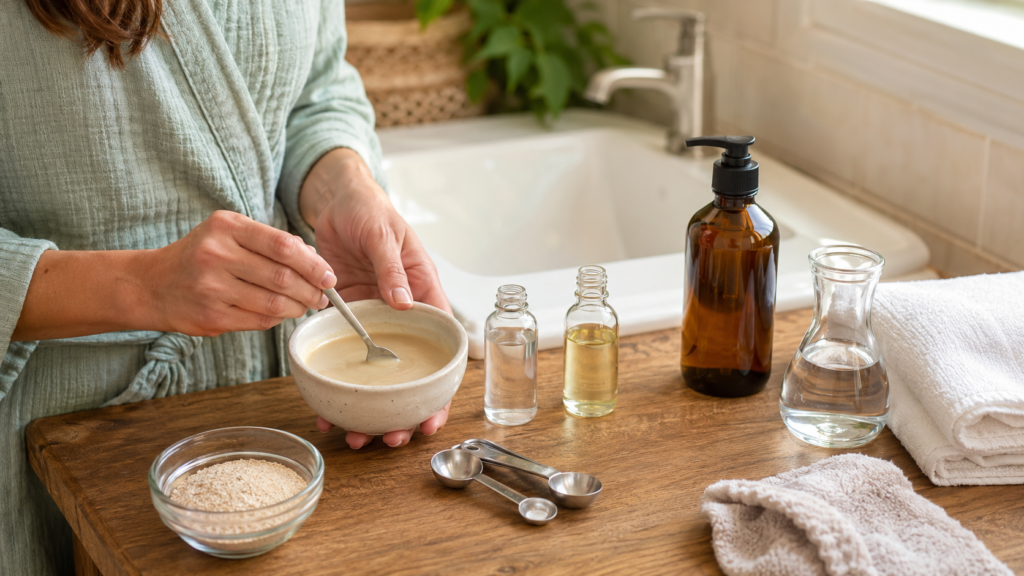
Making your own natural body wash can be a simple way to streamline your shower routine, especially if you prefer a short ingredient list and want to avoid heavily fragranced products. The key is keeping the project genuinely simple. A body wash does not need five oils, three extracts, and a tiny jar that will sit in the bathroom for six months collecting suspicious droplets.

The safest approach to DIY body wash is to make small, single-use batches. Once water, plant-based ingredients, or anything from the kitchen enters the mix, the formula can support microbial growth unless it contains a properly chosen preservative. That is why these recipes are designed to be mixed in a small bowl or cup right before use rather than stored in a pretty pump bottle indefinitely.

Affiliate disclosure: This article contains affiliate links. If you make a purchase through one of these links, I may earn a commission at no additional cost to you. As an Amazon Associate, I earn from qualifying purchases.

Start With a Simple, Skin-Friendly Setup

For basic natural body wash recipes, you do not need specialty equipment. A clean small bowl or cup, a spoon, and measuring spoons are enough.

The most useful base ingredient is unscented liquid castile soap. It creates lather, rinses away more easily than straight oils, and is widely available in grocery stores, pharmacies, and online. Because castile soap is concentrated, a little goes a long way.

A few practical ingredients can also add comfort or texture:

  • Vegetable glycerin: Helps the wash feel less squeaky and adds a little slip.
  • Finely ground colloidal oatmeal: Adds a soft, creamy feel, though it works best in a single-use mixture.
  • Plain sunflower or jojoba oil: Useful in small amounts for a richer feel, particularly if your skin tends to feel dry after showering.
  • Distilled water: A better choice than tap water when diluting soap, although it does not make homemade body wash shelf-stable.

Natural does not automatically mean gentle for everyone. Fragrance oils, essential oils, citrus extracts, and even some botanical ingredients can irritate sensitive skin. An unscented body wash may sound less exciting, but your skin is unlikely to complain about the lack of a “rainforest sunrise” scent.

A Basic Unscented Natural Body Wash

This is the most practical recipe if you want a straightforward cleanser with no added fragrance. It makes enough for one shower, so there is no need to worry about storage.

What you need

  • 2 tablespoons unscented liquid castile soap
  • 2 tablespoons distilled water
  • 1 teaspoon vegetable glycerin

How to make it

Combine the castile soap, distilled water, and glycerin in a clean cup or small bowl. Stir gently rather than whisking aggressively; otherwise, you will create plenty of foam before the mixture reaches the shower.

Pour a small amount onto a wet washcloth, shower puff, or your hands, then work it over damp skin and rinse well. The mixture will be thinner than a store-bought gel body wash because commercial formulas often contain thickeners. That is normal. Keep the cup on a stable shower shelf rather than trying to balance it on the edge of the tub like a tiny science experiment.

The practical benefit here is control. You know exactly what is in the wash, and the simple mixture is easy to use and rinse away.

A Creamy Oat Body Wash for a Softer Feel
Natural Body Wash_oatmeal wash

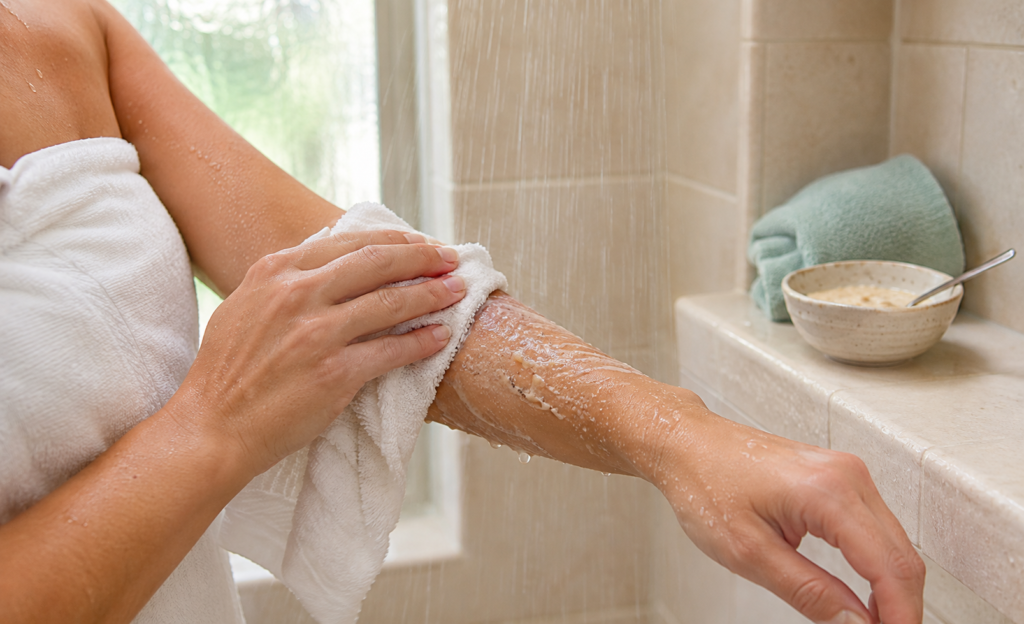
If you enjoy a body wash with a little more cushion, finely ground oatmeal can give a basic soap mixture a creamier texture. Choose colloidal oatmeal if possible. It is ground much finer than ordinary breakfast oats and mixes more smoothly with water.

What you need

  • 2 tablespoons unscented liquid castile soap
  • 1 tablespoon finely ground colloidal oatmeal
  • 1 tablespoon distilled water
  • 1 teaspoon vegetable glycerin

How to make it

Mix the oatmeal and water first, stirring until the mixture looks mostly smooth. Add the castile soap and glycerin, then stir gently until combined.

Use this body wash right away. Apply it with your hands or a soft washcloth, then rinse thoroughly. Because oatmeal can settle and leave residue, avoid sending large clumps down the drain. A quick rinse of the shower floor is worth the extra minute, especially if your tub has a textured surface where powdery ingredients like to linger.

This recipe is best if you prefer a creamy, low-lather cleanser. It is not the best choice if you want lots of bubbles or a very fast, no-fuss shower. In that case, the basic unscented version will be easier to use and clean up.

A Light Oil-Enhanced Body Wash
Natural Body Wash_oil enhanced

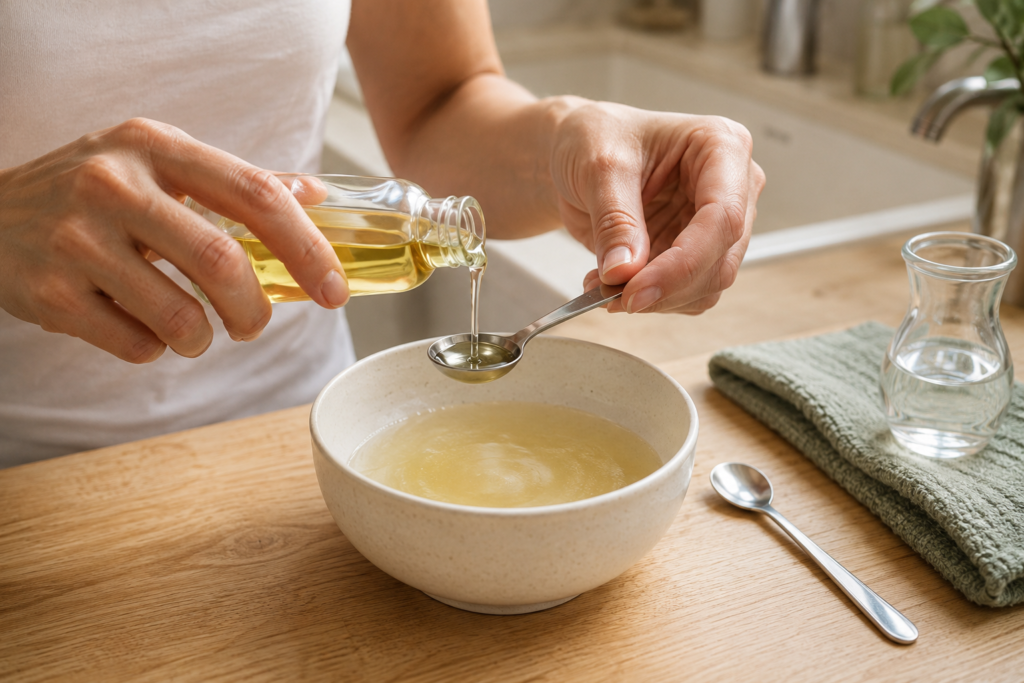
A little oil can make homemade body wash feel richer, but more is not necessarily better. Too much may leave a slippery shower floor and make the wash difficult to rinse away. Keep the amount modest and use the mixture immediately.

What you need

  • 2 tablespoons unscented liquid castile soap
  • 1 tablespoon distilled water
  • 1 teaspoon jojoba oil or sunflower oil
  • 1 teaspoon vegetable glycerin

How to make it

Add everything to a small cup and stir just before stepping into the shower. The oil may separate from the soap mixture—that is expected. Give it another quick stir or swirl before applying.

Use a washcloth or your hands to spread the mixture over wet skin, then rinse well. Rinse the tub or shower floor afterward to remove any remaining oil. This matters. A relaxing shower is great; an unexpectedly slick bathtub is not.

Jojoba oil is often chosen because it has a lighter feel, while sunflower oil is an accessible pantry option. If you use a kitchen oil, make sure it is fresh and properly stored. Oils can turn rancid over time, and a body wash is not where you want to discover that fact.

Keep Fragrance Optional

It can be tempting to add essential oils to every homemade body-care recipe, but they are entirely optional. Essential oils are concentrated plant extracts, not harmless drops of perfume, and they can cause irritation or allergic reactions.

Bramble Berry Oatmeal Milk Honey Fragrance Oil

For these simple body wash recipes, leaving essential oils out is the safest and easiest choice. They may not disperse evenly in a homemade mixture, which can expose your skin to concentrated droplets. Avoid applying essential oils to broken, freshly shaved, or irritated skin. Some citrus oils can also increase sensitivity to sunlight, depending on the oil and how it was processed.

An unscented formula lets your regular lotion, deodorant, or perfume do the heavy lifting on scent. You can also make your shower more pleasant with a clean towel, soft lighting, or music—no need to turn your soap recipe into a chemistry lab.

What Not to Add to Homemade Body Wash

Some popular DIY ingredients look appealing online but are not especially practical in body wash. Fresh fruit, milk, coconut milk, herbal tea, fresh aloe gel, and diluted honey can make a formula more difficult to preserve and clean up. When left in a warm, humid bathroom, mixtures containing these ingredients may spoil or support microbial growth.

Skip coarse sugar, coffee grounds, and large pieces of dried herbs, too. They can be abrasive, make a mess in the shower, and create drain cleanup you did not ask for.

If you want exfoliation, it is usually easier to use a separate washcloth, soft body brush, or gentle exfoliating glove occasionally, depending on what feels comfortable for your skin. That keeps your daily body wash simple and your shower drain less dramatic.

Storage, Cleanup, and Basic Safety

The easiest storage rule is this: make only what you plan to use that day. Small, single-use batches reduce contamination risk and waste while keeping the recipe manageable.

Do not store these water-based homemade body washes for weeks, even in a clean, capped container. Distilled water and clean equipment can reduce contamination, but they do not make an unpreserved formula shelf-stable. Discard any leftover mixture rather than saving it in the shower.

It is also smart to patch-test unfamiliar ingredients. Apply a small amount of the finished mixture to a limited area of skin, rinse it off, and pay attention to how your skin reacts. If it stings, burns, causes redness, or feels uncomfortable, stop using it.

Finally, liquid castile soap can be drying for some people, particularly in colder weather or after long, hot showers. If your skin feels tight afterward, use less soap, lower the water temperature, shorten your shower, or follow with a plain, fragrance-free moisturizer.

Final Thoughts

Simple natural body wash recipes work best when they stay simple: a soap base, a few optional additions, and a small batch mixed when you need it. There is no prize for creating a bathroom shelf full of half-used jars.

Start with the basic unscented version, then try adding oatmeal or a small amount of oil for a different texture. Homemade body wash should make your routine more pleasant—not give you another container to clean, store, and wonder about later.
You Might Also Enjoy

Keep on the Counter
House & Home

What to Keep on the Counter in a Small Kitchen—and What to Store Away

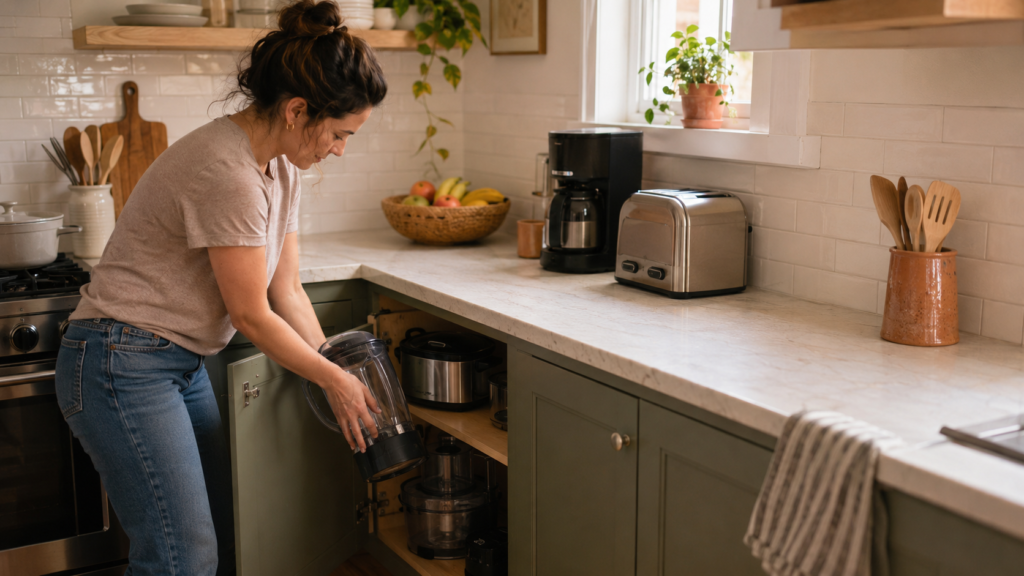
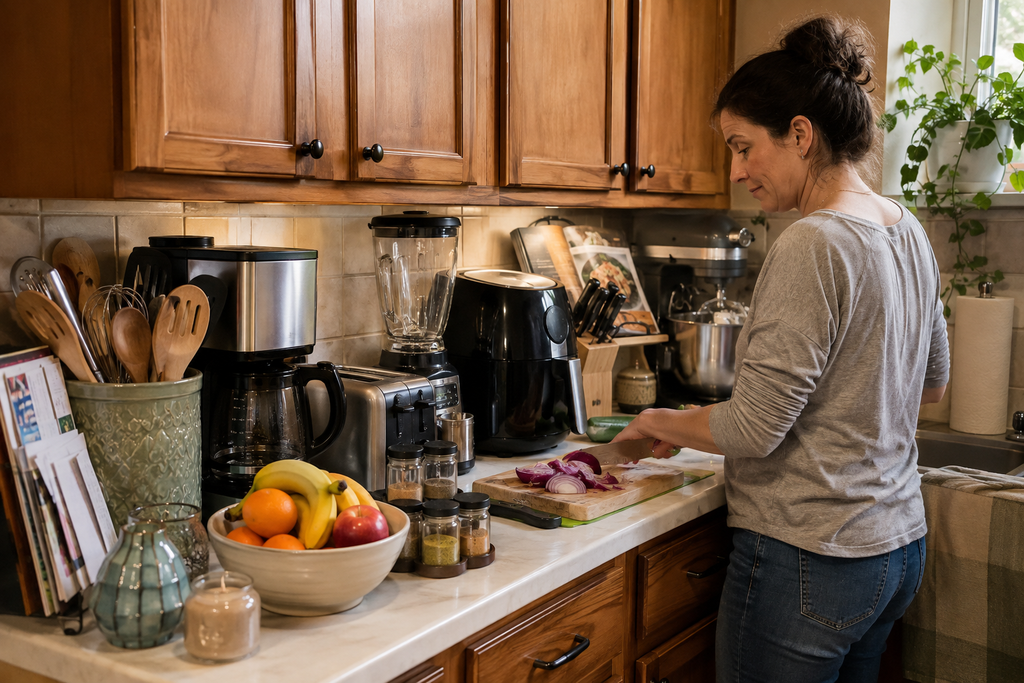
A small kitchen counter can become crowded surprisingly fast. One coffee maker turns into a coffee station, a toaster collects crumbs in the corner, and suddenly there’s nowhere to chop an onion without balancing a cutting board over the sink. The goal isn’t to make your kitchen look like no one cooks there. It’s to make the space work for the way you actually cook.

The best things to keep on the counter are items you use often enough to justify their footprint. Everything else can earn a cabinet, drawer, shelf, or pantry spot. That little bit of editing makes everyday cooking easier, speeds up cleanup, and keeps your kitchen from feeling like a game of appliance Tetris.

Affiliate disclosure: This article contains affiliate links. If you make a purchase through one of these links, I may earn a commission at no additional cost to you. As an Amazon Associate I earn from qualifying purchases.

Start With the Counter Space You Actually Have

Before deciding what stays out, take a realistic look at your usable workspace. A counter next to the stove may be technically available, but if it gets splattered with oil every time you sauté, it’s not the ideal home for a blender base or bowl of fruit. Likewise, the strip beside the sink is often valuable for washing and prep, even if it seems like a convenient place to park dishes forever.

In a small kitchen, it helps to think of the counter in zones:

  • Prep zone: Ideally near the sink, where you can wash produce, chop ingredients, and set out mixing bowls.
  • Cooking zone: The area closest to the stove, useful for utensils and ingredients you need while cooking.
  • Drink zone: Often where a coffee maker, electric kettle, or water filter works best.
  • Landing zone: A small designated place for groceries, mail, or items that need to be put away—not a permanent pile with its own weather system.

Try to preserve at least one clear section for meal prep. It doesn’t need to be huge. Even a cutting-board-sized open area makes weeknight cooking feel much more manageable. If every inch is occupied by appliances and containers, putting together a simple meal becomes unnecessarily annoying.

Keep Daily-Use Appliances Within Reach

Countertop appliances deserve space when they genuinely earn it. The simplest rule is this: If you use an appliance most days or several times a week, keeping it out can make sense. If it comes out twice a year for a specific recipe, it probably doesn’t need front-row seating.

A coffee maker is the classic example. If coffee is part of your morning routine, storing it in a cabinet between uses creates extra steps for little benefit. The same can apply to an electric kettle if you regularly make tea, oatmeal, instant soup, or pour-over coffee.

A toaster may also be worth keeping on the counter, especially in a household where toast, bagels, frozen waffles, or reheated pastries are frequent breakfast players. Leave enough clearance around it, follow the manufacturer’s placement guidance, and empty the crumb tray regularly. Crumbs have an impressive ability to migrate into places they were never invited.

A blender, stand mixer, air fryer, or food processor is more situational. These can be helpful tools, but they take up substantial physical and visual space. Consider keeping one out only if it matches your regular cooking habits:

  • Keep a blender out if you often make smoothies, sauces, soups, or dressings.
  • Keep a stand mixer out if you bake regularly and have a stable corner where it won’t interfere with prep space.
  • Keep an air fryer out if it’s one of your primary cooking tools, not just something you rediscover when you want crispy leftovers.
  • Store a food processor away unless you use it frequently for chopping, shredding, dips, doughs, or sauces.

If you’re uncertain, put an appliance away for two weeks. If you pull it out repeatedly, it has made its case. If you forget it exists, the cabinet was probably the right call.

Keep the Cooking Basics Handy, But Don’t Build a Countertop Store

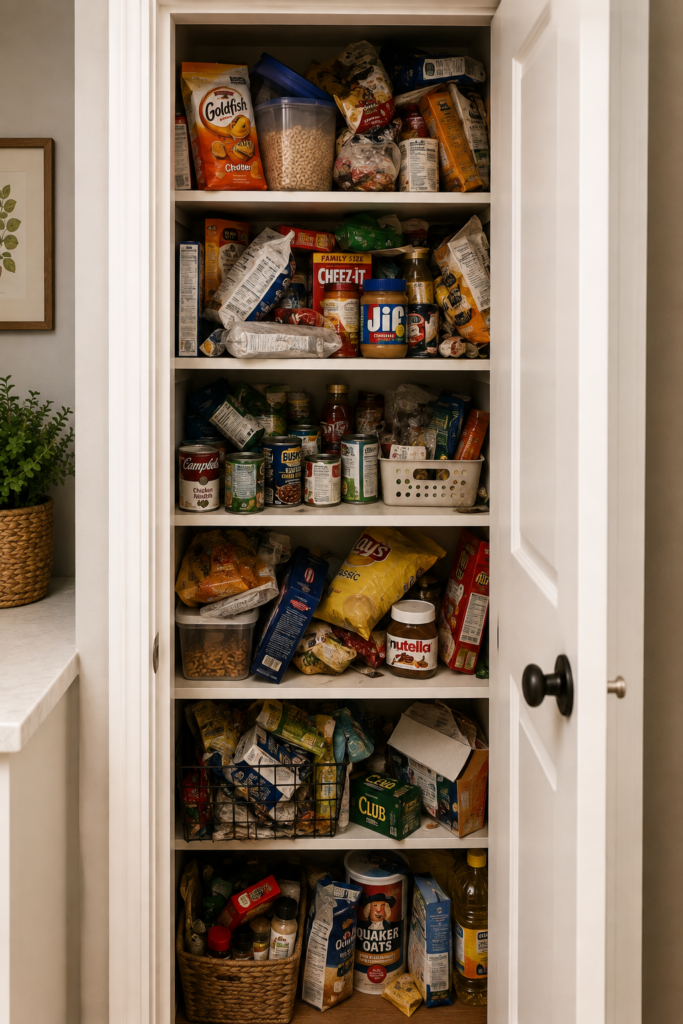
Keep on the Counter_clutter

A few cooking essentials can make your kitchen more functional when they stay close to the stove. A small container of frequently used utensils—such as a spatula, wooden spoon, tongs, and ladle—can save you from rummaging through a drawer while something is sizzling.

Choose a utensil crock or holder that’s easy to wash and large enough that the tools don’t jam together. Overstuffed containers defeat the purpose; you’ll still be digging around for the one turner that isn’t coated in mystery residue from last Tuesday’s pasta night.

A small bottle of cooking oil can also be practical if you use it regularly. Keep it away from direct heat and sunlight when possible, and wipe the outside occasionally. Oil bottles tend to develop a slippery film over time, particularly near a busy range.

Salt and pepper can stay out if you use them constantly, but avoid displaying an entire seasoning collection unless your kitchen has generous counter space. Spices lose quality faster when exposed to heat, humidity, and direct sunlight, so the area above or beside the stove is usually not the best long-term storage spot. A drawer, cabinet, or pantry shelf offers more protection and makes cleaning around the cooktop easier.

The same goes for knife blocks. They can be convenient, but they occupy valuable space and collect dust and crumbs around the slots. If counter space is tight, a drawer insert, a wall-mounted magnetic strip installed safely away from small children, or cabinet-mounted knife storage may be a better fit. Whatever method you use, make sure the blades are protected and dry rather than loose in a drawer.

A Few Food Items Belong Out—With Some Boundaries

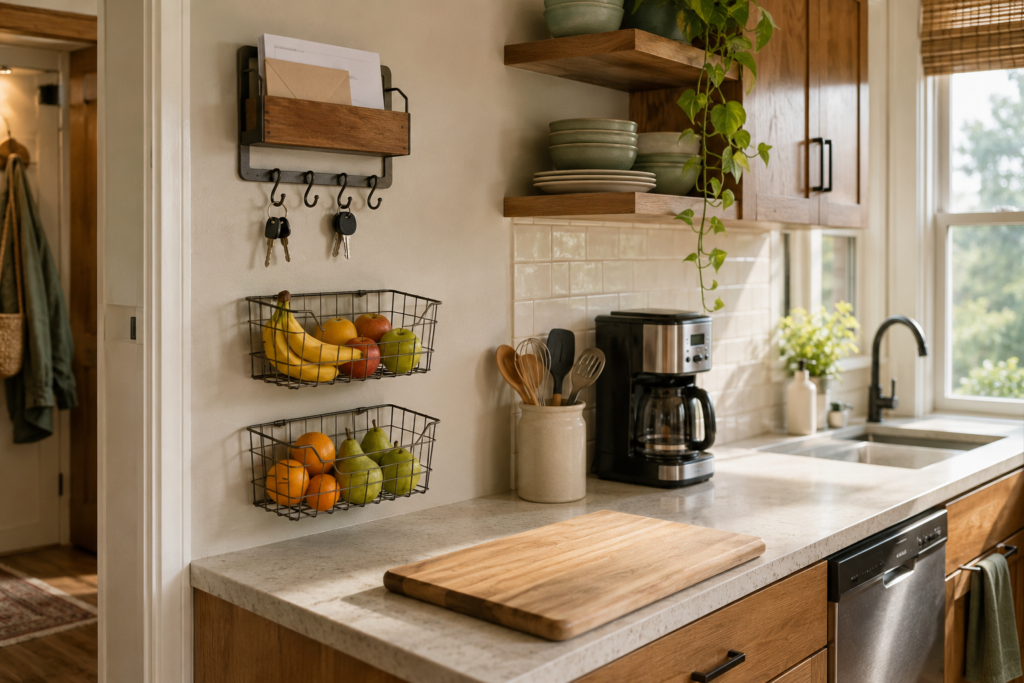
Not all food needs to disappear into the pantry. A fruit bowl can be useful and inviting, especially for produce that can ripen at room temperature, such as bananas, avocados, peaches, pears, and tomatoes. Seeing fruit may also make you more likely to eat it before it becomes an accidental science project.

That said, a fruit bowl or wall-basket isn’t the right answer for every piece of produce. Many fruits last longer in the refrigerator once ripe, and some release ethylene gas that can speed up ripening in nearby items. Bananas, apples, pears, and avocados are common ethylene producers. Separating them from ethylene-sensitive produce can help reduce premature spoilage.

Potatoes, onions, garlic, and winter squash are generally best kept in a cool, dry, dark place with airflow. The counter may work only if it stays relatively cool and out of direct sunlight. Store potatoes and onions separately, as keeping them together can shorten their storage life. A ventilated basket or bin in a pantry or suitable cabinet is usually more practical than a prominent counter display.

Bread can stay on the counter in a bread box or bag if you’ll use it within a few days. Keep it dry and away from heat. For longer storage, freezing bread is often more practical than refrigerating it, which can cause it to stale faster. Sliced bread can usually be toasted straight from frozen, one of those small kitchen wins that feels oddly satisfying.

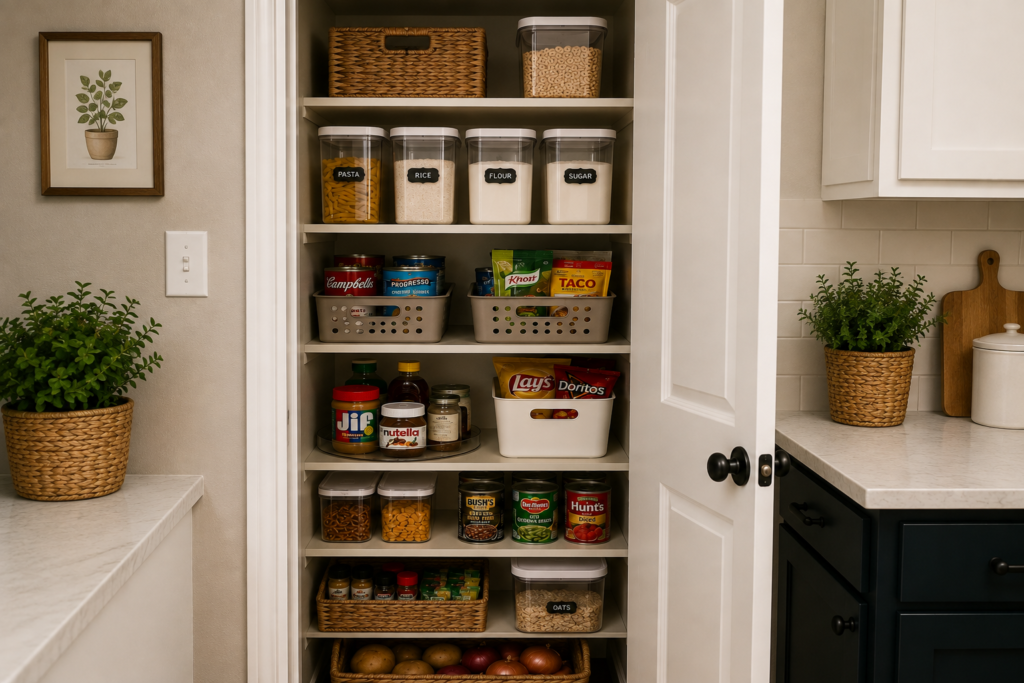
Keep on the Counter_clear the clutter

Store Away the Appliances With Occasional Jobs

Small kitchens benefit from being honest about “someday” tools. A waffle maker, panini press, slow cooker, rice cooker, ice cream maker, and electric griddle may all be useful, but usefulness alone doesn’t mean they need to live on the counter.

Store occasional appliances where you can still reach them without an archaeological dig. A lower cabinet, pantry shelf, or labeled bin works well for heavier pieces. If lifting a bulky appliance from a high shelf feels awkward or unsafe, choose a lower spot instead. Convenience matters, but so does not dropping a slow cooker on your toes.

Before putting an appliance away, let it cool completely, clean it according to its care instructions, and dry all removable parts thoroughly. Trapped moisture can lead to unpleasant odors or mildew, particularly in appliances with lids, seals, or narrow crevices.

It’s also worth keeping cords tidy. A simple hook-and-loop strap, built-in cord wrap, or loose loop secured with a reusable tie can prevent the cabinet from turning into a knot of power cords and grudges.

Move Paper, Packaging, and Decorative Extras Off the Work Surface

Some counter clutter has nothing to do with cooking. Mail, school papers, charging cables, prescription bottles, reusable shopping bags, and unopened packages often land in the kitchen because it’s the center of household traffic. Understandable. Still not helpful when you need room to roll dough.

A small tray can create a temporary landing spot for items that genuinely need attention soon. The key word is temporary. Sort it regularly so it doesn’t become a decorative basket of postponement.

Decor can also take up more room than expected. A candle, oversized vase, cookbook stand, faux plant, framed sign, and decorative tray may each seem harmless, but together they can consume the last usable stretch of counter. In a small kitchen, one or two decorative elements are usually enough. A bowl of fruit, a small plant placed safely away from the stove, or a favorite ceramic utensil holder can add warmth without sacrificing function.

Cookbooks are best stored on a shelf unless you actively use one throughout the week. If you like cooking from a book, pull it out for the recipe and return it when you’re done. That also protects it from splashes, flour dust, and the inevitable sauce drip.

Make Cleaning Easier by Leaving Some Breathing Room

An uncluttered counter isn’t just about appearances. It’s easier to clean thoroughly, which matters when you handle raw meat, eggs, unwashed produce, or messy ingredients. A crowded surface makes it harder to wipe up spills promptly and easier for crumbs, grease, and moisture to collect behind appliances.

Before preparing food, clear away nonessential items. Wash your hands, clean the counter, and use separate cutting boards for raw meat and ready-to-eat foods, or wash boards thoroughly between uses. Don’t put grocery bags, phones, or mail in the middle of your prep area. Those items travel through the world collecting whatever the world has to offer, and your dinner doesn’t need to meet all of it.

For everyday maintenance, wipe the counter after cooking and periodically move countertop appliances to clean underneath them. Check the manufacturer’s instructions before using cleaning products on appliance exteriors, natural stone, wood, or specialty finishes. A damp cloth and mild dish soap are often enough for routine messes, followed by a dry cloth where needed.

Let Your Kitchen Habits Decide

There isn’t one perfect list of what to keep on the counter in a small kitchen. If you bake bread every weekend, you may want a stand mixer within reach. If you mainly make simple stovetop meals, you may get more value from a clear prep area, a utensil holder, and a kettle.

Before an item claims permanent counter space, ask a few practical questions: Do you use it at least weekly? Is it difficult or unsafe to retrieve from storage? Does it make cooking easier enough to justify the space it takes? Can you clean around it without a hassle?

If the answer is mostly no, store it away. That doesn’t mean you made a bad purchase or need to get rid of it. It simply means your counter has a more important job.

Final Thoughts

A small kitchen works better when the counter supports your next meal rather than displaying every tool you own. Keep out the things that make your daily routine smoother, and give everything else a clean, accessible home.

The goal isn’t a bare showroom kitchen. It’s a kitchen with enough room to make coffee, chop vegetables, plate dinner, and maybe set down a grocery bag without triggering a minor avalanche.

You Might Also Enjoy

Pull-Out Cabinet Shelves vs. Shelf Risers
House & Home

Pull-Out Cabinet Shelves vs. Shelf Risers: Which Creates More Usable Space in a Small Kitchen?

Small kitchens rarely lack shelves; they lack reachable shelves. That’s why pull-out cabinet shelves and shelf risers are so often compared. Both can make a cramped cabinet more useful, but they solve different problems: one improves access to items in the back, while the other creates an extra level for things that would otherwise form a slightly alarming stack.

The better choice depends on what you store, how often you cook, and whether you’re ready to modify your cabinets. Pull-out shelves can turn deep lower cabinets into accessible storage, while shelf risers offer a simpler way to divide vertical space in upper cabinets, pantries, and even on counters. Neither is magic, sadly. But either can stop the “Where did that pan go?” routine.

Affiliate disclosure: This article contains affiliate links. If you make a purchase through one of these links, I may earn a commission at no additional cost to you. As an Amazon Associate I earn from qualifying purchases.

Comparison Overview

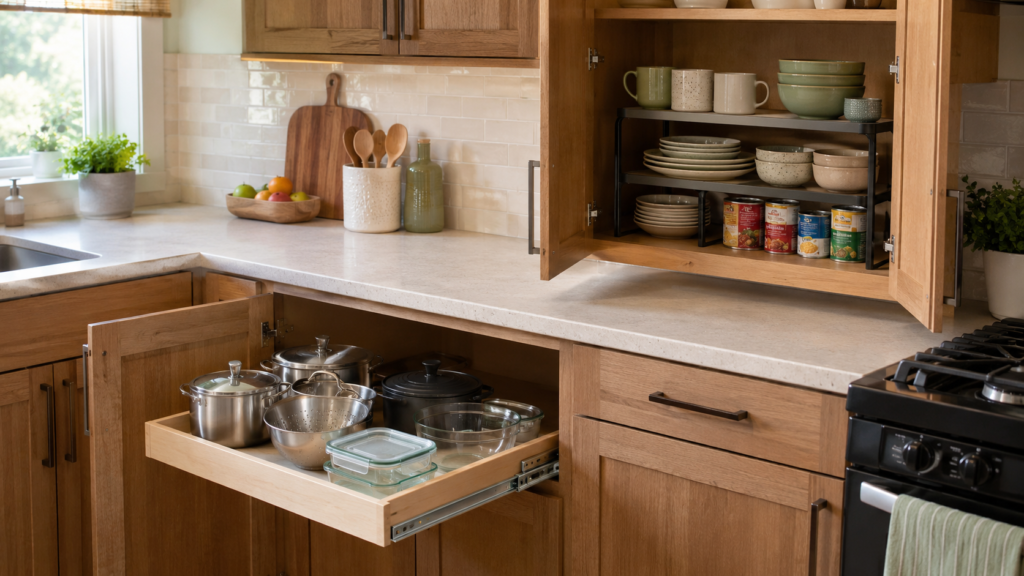
Pull-out cabinet shelves are trays or shelves installed inside a cabinet that slide forward on hardware. They are most useful in deep cabinets where canned goods, cookware, small appliances, or food containers tend to disappear behind whatever is in front. By bringing the contents toward you, they reduce reaching, kneeling, and unloading half the cabinet just to find one ingredient.

Shelf risers are freestanding platforms that sit on an existing shelf and create a second tier. They work best for shorter items such as mugs, bowls, plates, canned food, spices, snack boxes, and food-storage containers. They don’t pull anything closer, but they can prevent wasted air space above a short stack of dishes or pantry staples.

Side-by-Side Comparison

CriteriaPull-Out Cabinet ShelvesShelf Risers
Main purposeImproves access to items stored deep inside cabinetsCreates an additional level of vertical storage
Best cabinet locationDeep lower cabinets, pantry cabinets, and hard-to-reach shelvesUpper cabinets, shallow pantry shelves, and open shelving
InstallationUsually requires measuring and mounting hardwareGenerally sits directly on an existing shelf
AccessibilityBrings stored items forward for easier viewing and retrievalMakes stacked items easier to separate, but items in the back may still be hard to reach
Storage strengthsPots, pans, small appliances, dry goods, containers, and heavier everyday items when properly supportedMugs, dishes, canned goods, snack items, spices, and shorter containers
FlexibilityMore permanent once installed, though some systems can be adjusted or removedEasy to move, reposition, or reuse in another cabinet
Impact on shelf heightUses some vertical clearance for the shelf and sliding hardwareRequires enough room above and below the riser to make both levels practical
Cleanup considerationsCrumbs and spills can collect in the tray and around slide hardwareEasy to lift out and wipe down along with the cabinet shelf

Key Differences

Access Versus Extra Vertical Space

The biggest difference is simple: pull-out shelves improve access, while shelf risers improve vertical organization. A pull-out shelf is especially helpful when your cabinet is deep enough for items to migrate toward the back and establish a new life there. Instead of reaching over front-row cookware, you slide the contents toward you.

A shelf riser does not fix a deep-cabinet problem. It can make the front portion of a cabinet more organized, but it won’t bring that forgotten bag of rice forward. Its strength is preventing short items from sitting beneath a large pocket of unused space.

Installation Commitment

Shelf risers are the low-commitment option. Most require no drilling, hardware, or cabinet modifications. You measure your shelf, choose a riser that fits, place it inside, and reorganize. If your mugs turn out to be too tall or your cabinet isn’t as roomy as it looked in your imagination, you can move the riser elsewhere.

Pull-out cabinet shelves demand more planning. You’ll need accurate interior cabinet measurements, including width, depth, door clearance, hinges, and any obstructions. Some installations may be manageable as a DIY project, while others may be better handled by a cabinet professional. The prep matters because a poorly fitted pull-out shelf is just an expensive drawer that refuses to cooperate.

What They Can Store Well

Pull-out shelves suit a wide range of kitchen storage needs. They can make everyday cookware, baking dishes, mixing bowls, dry goods, and food containers easier to access. In lower cabinets, they can be particularly useful for heavier items that are awkward to retrieve from a low, deep shelf.

Shelf risers are better for lighter, stackable, or easily visible items. Think drinking glasses, bowls, canned tomatoes, tea boxes, lunch containers, or rows of spices. They are not always ideal for large pots, tall bottles, or bulky appliances because those items can make the levels feel cramped or unstable.

Space Efficiency Depends on the Cabinet

A riser may create more usable space in an upper cabinet that holds mugs or dishes because it divides open vertical space into two practical levels. If the shelf is tall enough, one riser can make room for two neat rows where there was previously one short stack and a lot of empty air.

In a deep lower cabinet, however, a pull-out shelf may create more usable space even if it does not add another level. A cabinet packed from front to back is not particularly helpful if you can reach only the first few items without crouching and excavating. Pull-outs make the cabinet’s full depth easier to use.

Cabinet Compatibility and Clearance

Shelf risers require enough height to work. A riser that technically fits but leaves only an inch or two above the lower level won’t help much. Before choosing one, measure the cabinet’s interior height and the items you plan to store.

Expandable adjustable stackable kitchen cabinet organizer

Pull-out shelves require different kinds of clearance. The cabinet needs enough interior width and depth for the shelf and its sliding mechanism, and the door must open wide enough for the shelf to extend. Face-frame cabinets, exposed hinges, plumbing, and fixed shelf supports can all affect compatibility. Measuring first is not glamorous, but neither is returning a storage solution that almost fits.

Performance and Everyday Use

Daily Cooking and Meal Prep

If you cook often, pull-out cabinet shelves can make daily kitchen work smoother. Keeping mixing bowls, pans, food containers, or dry ingredients on pull-outs means less reaching and rearranging before dinner. They are particularly useful when you use the same cabinet items several times a week.

Shelf risers work well for frequently grabbed pantry items and dishes. A riser can give breakfast bowls their own level, keep lunch containers from collapsing into a plastic avalanche, or make canned goods easier to scan. They are less useful in a cabinet full of large cookware, where the riser may simply get in the way.

Deep Cabinets and Low Storage

Deep, low cabinets are where pull-out shelves shine. Fixed shelves often force you to choose between storing items in front, where they’re accessible, or using the full depth and accepting that the back section may become a mystery zone. Pull-outs reduce that trade-off.

Expandable Pull Out Cabinet Organizer

Shelf risers can still help in lower cabinets, but only in certain situations. They may work for lightweight pantry goods or short containers if there is enough vertical room. They are usually less practical for heavy Dutch ovens, stacks of pans, or oversized serving pieces that need stable, open storage.

Upper Cabinets and Pantry Shelves

Upper cabinets often favor shelf risers because vertical space is commonly the issue. If one shelf holds short glasses, mugs, or small bowls with a large gap above them, a riser can help the cabinet hold more without making it feel overstuffed.

Pull-out shelves can work in pantry cabinets and some upper cabinets, especially when the shelves are deep. Still, their installation and added structure may not be necessary for a shallow cabinet. In that situation, a riser can provide a quicker, less involved improvement.

Flexibility for Changing Kitchens

Shelf risers are easy to adapt as your kitchen changes. You can move them from a dish cabinet to a pantry shelf or repurpose them outside the kitchen. This flexibility is useful for renters, temporary living arrangements, or anyone still figuring out how their kitchen works.

Pull-out shelves are more of a long-term organizational decision. They can be worthwhile when a cabinet has a clear, ongoing job, such as holding cookware or pantry staples. But if you frequently change cabinet layouts or expect to move soon, a removable riser may make more sense.

Durability and Maintenance

Pull-out cabinet shelves have more components to maintain. The shelf surface should be wiped regularly, especially if it holds dry goods, baking supplies, or containers that may leak. Sliding hardware can collect dust and crumbs over time, so it should stay clear of loose debris to keep the shelf moving smoothly. If a track, mounting point, or drawer mechanism becomes damaged, repairs may require replacement parts or more involved cabinet work.

Shelf risers are generally simpler to maintain because they have no moving parts. Most can be removed, wiped clean, and returned to the cabinet in minutes. Their long-term durability depends on the material, construction, and weight placed on them. Avoid overloading a riser or using it to support items that feel unsteady, particularly glassware or tall stacks of dishes. A simple organizer is helpful only until it becomes a tiny elevated hazard.

Cost and Overall Value

Shelf risers are often the better value when your main issue is wasted vertical space. They require little installation effort and can be moved if your needs change. For a cabinet of mugs, canned goods, or small dishes, a basic riser may solve the problem without turning it into a larger storage project.

Pull-out shelves can justify a higher investment when access is the bigger frustration. If you regularly struggle to reach cookware, pantry goods, or containers in the back of deep cabinets, better access may be more valuable than adding another shelf level. Their value increases when they improve a cabinet you use every day, not one reserved for the once-a-year roasting pan.

Who Should Choose Each Option

The Renter or Low-Commitment Organizer

Shelf risers are usually the better fit if you rent, want to avoid cabinet modifications, or need a solution you can move later. They provide a noticeable storage improvement without permanent installation and can be repositioned as your kitchen setup evolves.

The Frequent Home Cook With Deep Lower Cabinets

Pull-out cabinet shelves are likely the better choice if you cook often and keep pans, bowls, ingredients, or containers in deep lower cabinets. They make those items easier to reach and can reduce the repeated reaching and shifting that fixed shelves tend to require.

The Small-Pantry Household

Shelf risers work well for a small pantry filled with short packaged foods, canned goods, snacks, tea, and jars. They can help you use open vertical space while keeping labels visible. Just avoid creating crowded levels that make items difficult to remove safely.

The Cookware Collector

Pull-out shelves are generally more useful for cookware, bakeware, and heavier kitchen tools, provided the cabinet and hardware are designed to support the load. A riser may help separate lids or small pans in some cases, but it is rarely the most practical answer for a cabinet packed with bulky pieces.

The Upper-Cabinet Space Maximizer

Shelf risers are usually the more sensible option for upper cabinets holding mugs, glasses, bowls, or plates. They can turn a single tall shelf into two accessible zones without requiring a more complex overhead installation.

Final Verdict

Pull-out cabinet shelves and shelf risers create usable space in different ways. Pull-outs make deep storage easier to reach, which can be a major improvement in lower cabinets and heavily used pantries. Shelf risers add vertical levels, making them especially helpful in upper cabinets and for collections of shorter kitchen items.

Choose pull-out cabinet shelves when accessibility is the real problem: items are buried, cabinets are deep, and everyday cooking involves too much reaching or rearranging. Choose shelf risers when you have unused vertical room and want a simple, flexible way to organize lighter items. The best small-kitchen upgrade is the one that fixes the frustration you actually have, not the one that merely looks organized for five minutes.

Frequently Asked Questions

Do pull-out shelves create more space than shelf risers?

Pull-out shelves usually create more usable space in deep cabinets because they make the back area accessible. Shelf risers may create more vertical storage capacity when there is unused height above shorter items.

Are shelf risers safe for dishes and glassware?

They can be, as long as the riser is stable, placed on a level shelf, and not overloaded. Store heavier items on the lower level when possible, and avoid stacking glassware where it could be easily knocked over.

Can pull-out shelves be installed in any cabinet?

Not always. Cabinet width, depth, door clearance, hinges, interior frames, plumbing, and fixed shelves can affect whether a pull-out system will fit and operate properly.

Are shelf risers useful in lower cabinets?

They can be useful for lightweight pantry goods or containers, but they are often less effective in deep lower cabinets or for heavy cookware. Pull-out shelves are usually more practical when access is the main issue.

Which option is easier to clean?

Shelf risers are usually easier because they can be lifted out and wiped down. Pull-out shelves also need regular cleaning, but crumbs and spills may collect around the sliding hardware and inside the cabinet.

You Might Also Enjoy

Eco-Friendly Fashion
Trending

Navigating the World of Eco-Friendly Fashion

Eco-friendly fashion can feel like one of those topics that comes with a surprise pop quiz: Know your fabrics, research every brand, never impulse-buy, repair everything, and somehow become an expert in supply chains before lunch.

In real life, a more sustainable wardrobe usually starts closer to home. It begins with knowing what you own, choosing clothes you’ll genuinely wear, caring for them well, and making room for the occasional fun purchase without turning your closet into a textile traffic jam.

The goal isn’t a flawless “capsule wardrobe” in shades of oatmeal. It’s a clothing system that works for your life, your space, and your budget.

Start With the Clothes You Already Own

The most practical place to begin with eco-friendly fashion is your current closet, dresser, or chair-that-has-become-a-clothing-storage-system. Before buying anything new, look at what is already there.

Pull out the items you wear regularly, the pieces that need a small repair, and the clothing that no longer fits your life. That doesn’t mean you need to do a dramatic, all-weekend purge. Starting with a single drawer, one category, or a seasonal swap is enough.

As you sort, ask a few useful questions:

  • Do I wear this comfortably?
  • Does it work with other clothes I own?
  • Is it worth repairing, altering, or cleaning properly?
  • Am I keeping it out of habit, guilt, or because I might need it for a very specific imaginary event?
  • Could someone else use it more than I do?

This kind of edit helps you see clothing as part of a working home system, not just a collection of purchases. A closet packed with forgotten items makes getting dressed harder, which can lead to buying more “easy” options you don’t actually need.

Keep what supports your routine. That might include work clothes, favorite jeans, sentimental T-shirts, occasion wear, soft clothes for resting at home, or the slightly ridiculous sweater that makes you happy every December. Sustainable fashion does not require dressing like a catalog display.

Buy Less Often, but Buy With a Plan

Buying less is often the simplest way to reduce wardrobe waste, but “buy less” doesn’t have to mean “buy nothing.” Clothes wear out. Bodies change. Jobs change. Weather happens. Sometimes you simply need a coat.

The difference is planning before you shop.

Instead of browsing because you feel vaguely uninspired by your closet, identify the actual gap. Maybe you need trousers that work for both the office and dinner plans. Maybe your child needs a warmer layer. Maybe your everyday shoes have reached the point where “character” is no longer the right word for their condition.

A short shopping list can keep purchases practical:

  • The item you need
  • The colors or styles that work with your existing wardrobe
  • The weather or activity it needs to handle
  • A realistic budget
  • Whether you can wear it in several ways

This approach also works well in small homes and shared closets. Every item takes up physical space, visual space, and mental space. When clothing has a clear job, it earns its hanger, drawer spot, or under-bed storage bin.

For renters or anyone without a generous closet, try setting limits based on available storage rather than chasing an arbitrary number of items. If your dresser drawers close easily and you can see what you own, the system is probably doing its job.

Learn What Makes a Garment More Sustainable

Eco-friendly fashion is not as simple as finding one perfect fabric or label. A garment’s impact can involve the materials used, how it was made, how far it traveled, how long it lasts, and what happens when you’re done with it.

That’s a lot to put on a shirt tag, so focus on a few manageable factors.

Eco-Friendly Fashion; Detailed view of fabric texture with an embroidered logo in a neutral color scheme.
Photo by Vitalii Abakumov

Natural fibers such as cotton, linen, wool, and silk are familiar choices, but they vary widely in how they are produced and maintained. Synthetic fabrics, including polyester and nylon, can be durable and useful for certain items, especially activewear and outerwear, but they are generally made from fossil-fuel-based materials. Blended fabrics can be practical, though they may be more difficult to recycle at the end of their usable life.

Rather than trying to memorize every material, consider these everyday questions:

  • Does the fabric suit the garment’s purpose?
  • Does it feel durable enough for how often you’ll wear it?
  • Can you care for it without a complicated routine you won’t realistically follow?
  • Is the construction sturdy, with secure seams, functional details, and closures that seem likely to last?
  • Is this something you’ll want to wear beyond one trend cycle?

A well-loved item that stays in your wardrobe for years is generally a better outcome than a “sustainable” purchase that sits unworn with the tags still on. The tags are not judging you, but they are taking up shelf space.

Make Secondhand Shopping Work for Your Home and Style

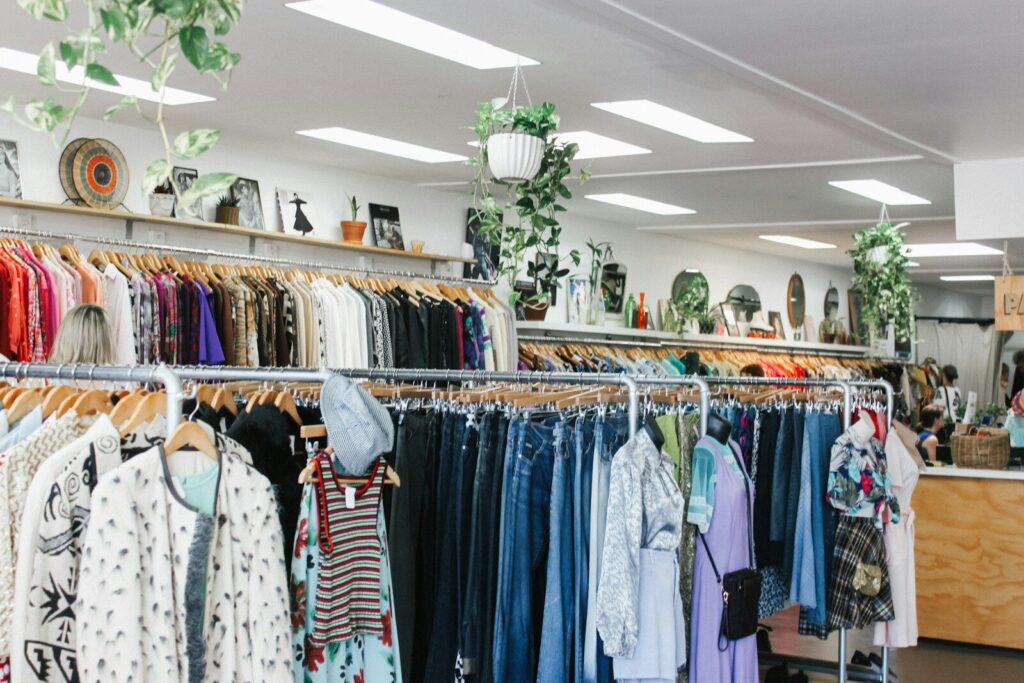
Secondhand clothing can be a useful part of an eco-friendly fashion routine because it gives existing items another chance to be worn. It can also be a budget-friendly way to find quality materials, unusual pieces, children’s clothing, or special-occasion outfits that may only be worn a few times.

Eco-Friendly Fashion; assorted-color clothes hanged inside department store with lights turned on
Photo by Prudence Earl

Still, secondhand shopping can create clutter just as easily as buying new. A low price is not a reason to bring home something that doesn’t fit, doesn’t suit your routine, or needs repairs you know you won’t make.

Shop secondhand with the same filters you would use anywhere else. Look for items that fit your shopping list, work with your existing wardrobe, and can be stored properly at home.

When shopping online, pay close attention to measurements and condition details. When shopping in person, check seams, zippers, hems, linings, and areas that get heavy wear. A small stain may be manageable. A missing button may be an easy fix. A damaged zipper on a complicated garment might be more trouble than it’s worth.

You can also try local swaps, community groups, consignment options, and hand-me-down networks. These choices can be especially helpful for maternity clothes, children’s sizes, costumes, and clothing needed for a short-term event.

The key is circulation, not accumulation. Secondhand does not automatically mean necessary.

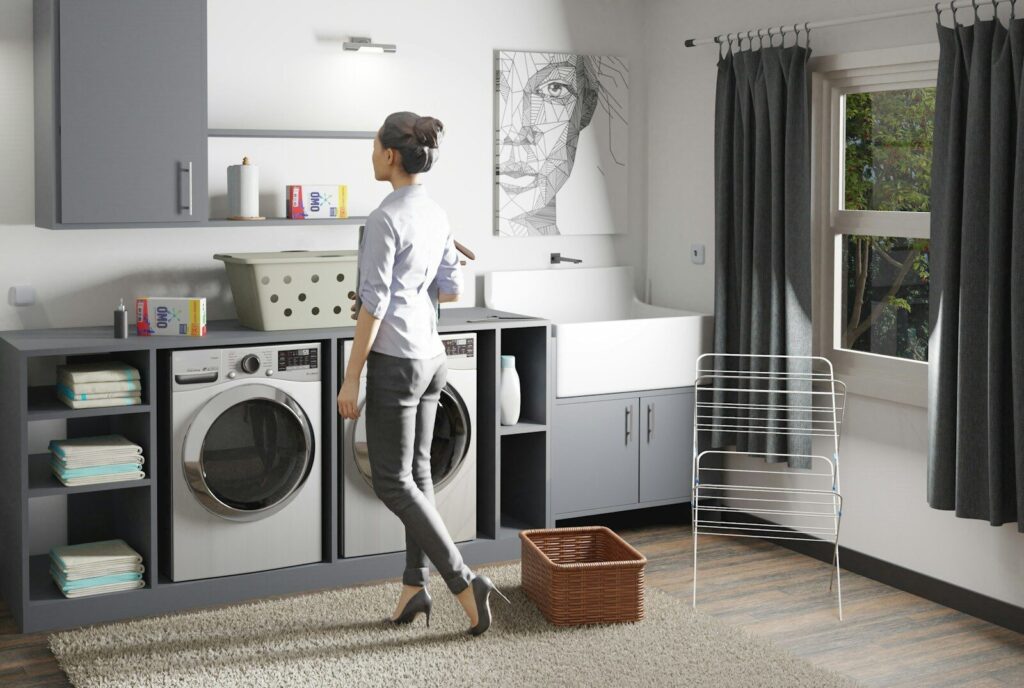
Care for Clothes Like They’re Part of Your Household System

Laundry is where eco-friendly fashion becomes very ordinary, very quickly. It is also where you can extend the life of clothes you already have.

A simple care routine can reduce unnecessary wear:

a woman standing in a laundry room next to a washer and dryer
Photo by Sufyan
  • Wash clothing when it actually needs washing rather than after every brief use.
  • Follow care labels, especially for delicate fabrics and structured garments.
  • Turn printed or dark clothing inside out when appropriate.
  • Use a laundry setup that prevents small items from disappearing into another dimension.
  • Air-dry items that may shrink, lose shape, or wear out faster in high heat.
  • Make sure clothes are completely dry before storing them to help prevent odors or mildew.

You do not need a Pinterest-worthy laundry room for this. A small basket for items needing repair, a designated spot for air-drying, and a place to keep stain treatment can make a big difference. In a compact apartment, an over-the-door rack, folding drying rack, or a few sturdy hangers may be enough.

Good storage matters too. Sweaters often hold their shape better when folded, while jackets, dresses, and button-down shirts are easier to find on hangers. Clean seasonal clothing before storing it, and use breathable storage options when possible. The aim is not to preserve every garment forever; it is to prevent avoidable damage.

Repair, Alter, and Rewear What Still Has Life Left

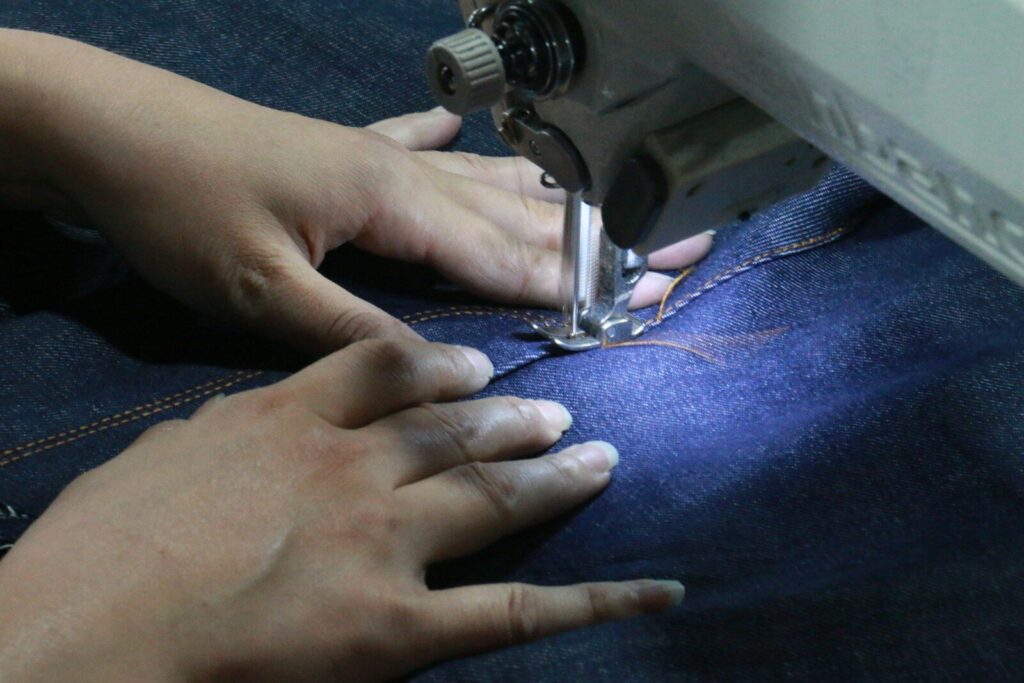
A loose button, fallen hem, or tiny tear does not have to end a garment’s useful life. Basic repair skills can be helpful, but they are not a requirement for participating in sustainable fashion. A tailor, alteration shop, cobbler, or handy family member may be a better fit for more complicated fixes.

Eco-Friendly Fashion; a woman using a sewing machine to sew jeans
Photo by reza erfanian

Start with repairs that match your comfort level. Sewing on a button or using an iron-on patch can be manageable for many people. Replacing a zipper, resizing a formal outfit, or repairing leather shoes may call for professional help.

Alterations can also make clothing more wearable. A pair of pants that is slightly too long, a dress that needs adjusting, or a blazer that could fit better may become a regular favorite after a small change. Before paying for alterations, consider the garment’s condition and how often you expect to wear it. Not every item needs saving, and that’s okay.

Rewearing matters just as much. Styling the same piece differently—with layers, shoes, accessories, or a change in proportions—can help your closet feel more versatile without adding more clothing. A favorite black dress can do plenty of work. It does not need a new supporting cast every time it leaves the house.

Let Your Closet Support Real Life, Not Fantasy Life

An eco-friendly wardrobe is easier to maintain when it reflects the life you actually lead. If you work from home, you may need fewer formal clothes and more comfortable layers. If you commute, durable shoes and weather-ready outerwear might matter most. If laundry access is limited, easy-care items can be a practical priority.

This is where organization and sustainability overlap. When your clothes are visible, accessible, and suited to your routine, you are more likely to wear what you own.

Try grouping clothing by how you use it: work, everyday, exercise, occasions, lounge, or seasonal needs. In a small closet, keep current-season favorites at eye level and move less-used items higher up or into labeled storage. If mobility or accessibility is a concern, place frequently worn pieces where they are easiest to reach, and use drawers, bins, or hangers that do not require difficult lifting.

A wardrobe should make mornings easier, not create a daily negotiation with a pile of clothes that all seem to have opinions.

Final Thoughts

Navigating eco-friendly fashion does not require a perfect wardrobe, a huge budget, or a total style reinvention. It can be as practical as wearing what you already love, buying with more intention, caring for clothes properly, and passing along what no longer serves you.

The best system is one you can maintain. A closet that fits your home, your habits, and your actual life will always be more useful than a trendy ideal that looks good only from a distance.

You Might Also Enjoy

Standing Desk vs. Traditional Desk
House & Home

Standing Desk vs. Traditional Desk: Which Desk Is Right for You?

When comparing a standing desk vs. traditional desk, the right choice comes down to more than whether you prefer sitting or standing. Your available space, work routine, equipment, budget, and willingness to adjust your setup all matter. A desk is one of those everyday items that can quietly make a room easier to use—or become the place where cables, paperwork, and mystery mugs gather.

Adjustable standing desks let you change your work height, while traditional desks provide a fixed surface designed mainly for seated use. Neither is automatically better. The right desk is the one that fits how you actually work, study, create, plan meals, pay bills, or occasionally open your laptop while pretending you are not also watching a recipe video.

Comparison Overview

Standing desks and traditional desks serve the same basic purpose: giving you a dedicated work surface. The main difference is flexibility. Most standing desks can be raised or lowered to support different working positions, while a traditional desk stays at one fixed height.

For many households, the decision also affects the surrounding room. An electric standing desk needs access to power, and any adjustable model requires enough clearance to move upward safely. A traditional desk is often simpler to place, especially in a small office, bedroom, kitchen corner, or multipurpose room where furniture needs to stay put.

Side-by-Side Comparison

CriteriaStanding DeskTraditional Desk
Work positionSupports sitting and standing when adjustablePrimarily supports seated work
Height adjustmentMay use manual or electric adjustmentFixed height
Setup complexityCan require assembly, power access, and cable planningUsually has a simpler setup
Moving partsAdjustable models include mechanisms that may need occasional attentionTypically has fewer moving parts
Space needsRequires overhead and surrounding clearance when raisedNeeds a consistent footprint
Desk accessoriesMay benefit from monitor arms, cable management, or adjustable accessories at different heightsWorks easily with standard seated office accessories
Budget rangeAdjustable mechanisms can increase the costBasic fixed desks are often the simpler, lower-cost option
Best fitPeople who want position flexibility during the dayPeople who prefer a straightforward, stable seated setup

Key Differences

Adjustability Versus Simplicity

The central difference is obvious but important: adjustable standing desks can change height, while traditional desks cannot. That flexibility is useful if your day includes long stretches of computer work and you want to switch positions without leaving your workspace.

A traditional desk keeps things refreshingly uncomplicated. There is no control panel, crank, lifting column, or question about whether the desktop is high enough for your monitor setup. If you are comfortable working seated and do not need regular height changes, fixed furniture may be all you need.

Room Layout and Clearance

A standing desk needs room to travel upward. That sounds simple until you place it beneath shelves, wall cabinets, a window ledge, or a low ceiling feature. In a compact apartment or kitchen-adjacent workspace, measure the intended location carefully before choosing an adjustable model.

Traditional desks are easier to plan around because their height never changes. They can fit neatly under wall shelves or into a built-in nook without causing a surprise collision later. That predictability is especially helpful in shared rooms where every inch has a job.

Stability at Different Heights

A well-designed standing desk should provide a stable work surface throughout its intended height range, but wobble can become more noticeable when the desktop is raised. A tall monitor, heavy desktop computer, uneven floor, or less-rigid frame can all affect how steady the setup feels.

Traditional desks have the advantage of a fixed, lower work surface. That does not mean every fixed desk is rock-solid—construction and assembly still matter—but there are fewer variables once it is in place. For detailed tasks such as drawing, writing, gaming, or working with small tools, that consistency may be appealing.

Accessories and Ergonomic Fit

Changing the desk height also changes how your accessories are positioned. Your monitor, keyboard, mouse, laptop stand, and task light should remain comfortable to use whether you are seated or standing. Monitor arms and adjustable keyboard trays can make the transition smoother, though they are not essential for every setup.

With a traditional desk, you can arrange one seated workstation and leave it alone. A supportive chair and sensible monitor placement still matter, but you do not have to make the same workstation suit two different heights. Less adjusting can be a real benefit if you value a tidy, low-fuss setup.

Mechanical Features and Long-Term Considerations

Standing desks with lifting mechanisms offer more flexibility but also include more components. Electric models need a nearby outlet and add cords to manage. Manual models avoid the power requirement but may take more effort to adjust. Neither approach is inherently troublesome, but both are worth considering before you buy.

Traditional desks generally rely on straightforward construction: legs, a frame, a desktop, drawers, and perhaps a cable opening. Fewer mechanical components can make them easier to understand, assemble, and maintain over time. Sometimes boring furniture is exactly what you want. Boring furniture rarely asks for troubleshooting.

Performance and Everyday Use

Switching Positions During a Workday

A standing desk is useful when you want to alternate between seated and standing work. That does not mean you need to stand all day, and it does not require turning every email into a fitness event. The practical benefit is choice: you can raise the surface for part of the day, then lower it when you want to sit.

A traditional desk is better suited to a mostly seated routine. It provides a consistent setup without interruption, which can work well for focused computer tasks, handwriting, online classes, or projects that require you to remain in one position for a while.

Managing Technology and Cables

Standing desks require more cable planning because monitor, charger, lamp, and computer cords need enough slack to move safely with the surface. Cable trays, clips, and mounted power strips can keep cords from dangling or catching, but they add another step to the setup process.

Traditional desks simplify cable management because the equipment remains at the same height. If your workspace includes a printer, external drives, speakers, or other connected equipment, a fixed desk can make it easier to keep everything connected and contained.

Working in Small or Shared Spaces

In a dedicated office, a standing desk may be easy to accommodate. In a shared bedroom, dining room, or compact kitchen-adjacent corner, its changing height can be less convenient. The desk needs clear space above it, along with enough room for a chair when the surface is lowered.

Traditional desks work well in rooms that pull double duty. Their fixed profile can sit beneath shelves, beside a dining table, or against a wall without changing the layout each time someone uses the space. If your desk needs to blend into daily household life rather than dominate it, that can be a meaningful advantage.

Durability and Maintenance

Standing desks benefit from occasional basic care. Keep the lifting area clear, stay within the manufacturer’s stated weight capacity, check that fasteners remain secure, and arrange cables so they do not snag during height changes. With electric models, the power connection and control system are also part of long-term ownership. A desk mat or coasters can help protect the desktop from drink rings, scratches, and the inevitable drip from a rushed lunch at the keyboard.

Traditional desks usually need simpler maintenance, such as dusting, wiping up spills promptly, tightening hardware, and caring for the desktop according to its finish. Drawers and hinges may eventually need adjustment, but fixed desks generally have fewer parts to inspect. If easy repairs and minimal upkeep are priorities, a sturdy traditional desk can be the more straightforward long-term choice.

Cost and Overall Value

Standing desks can cost more because adjustable frames and lifting systems add complexity. Paying more may make sense if you expect to use the height adjustment regularly or need the desk to support a larger monitor setup or multiple work tools. The value comes from using that flexibility, not simply owning a desk that goes up and down.

A traditional desk may offer better value when you need a dependable surface for seated work and do not expect to change positions often. The money saved can go toward a comfortable chair, useful lighting, storage, or cable management—items that can improve a workspace just as much as a more elaborate desk frame. A less expensive desk may be all you need if it fits your room, supports your equipment, and feels stable.

Who Should Choose Each Option

The Person Who Wants More Position Flexibility

A standing desk is likely the better fit if you want to change your work position throughout the day. It can suit remote work, study sessions, creative projects, and household administration when you do not want to remain seated for every task. Just make sure you have room for the desk to rise, along with a plan for cords and accessories.

The Seated Worker With a Stable Routine

A traditional desk is a strong choice if you do most of your work while sitting and prefer a set-it-and-forget-it arrangement. It can be especially practical if you use a desktop computer, write by hand, game, sew, or complete detailed work that benefits from a stable surface at one familiar height.

The Small-Space Household

A traditional desk may fit better in a small home office, bedroom, kitchen corner, or shared living area. Its fixed dimensions make room planning easier, and it can often sit beneath shelves or cabinets that would limit a standing desk’s movement.

The Dedicated Home Office User

A standing desk can make sense in a dedicated office where you have enough clearance, power access, and space for a chair and other equipment. If the room is built around work rather than shared with meals, guests, or storage, it is easier to take full advantage of an adjustable setup.

The Budget-Conscious Buyer

A traditional desk is often the more sensible starting point when your budget is limited. Look for a stable design with enough surface area and storage for your actual needs. Height adjustment is useful, but it is not essential for every workspace.

Final Verdict

Standing desks are best for people who value the ability to move between sitting and standing and have enough space for an adjustable workstation. They require more planning around cables, clearance, accessories, and possible mechanical upkeep, but that flexibility can be worthwhile when it matches your daily routine.

Traditional desks remain an excellent choice for seated work, smaller rooms, stable setups, and simpler budgets. Choose a standing desk if adjustable height is a feature you will genuinely use. Choose a traditional desk if consistency, simplicity, and easy placement matter more.

Ultimately, the standing desk vs. traditional desk decision depends on how you work, how much room you have, and whether you will genuinely use the adjustable height.

Frequently Asked Questions

Is a standing desk better than a traditional desk?

Not universally. A standing desk is better if you want adjustable working positions, while a traditional desk is better if you prefer a simple, stable setup for seated work.

Do standing desks require electricity?

Some do. Electric standing desks need power, while manual models may use a crank, lever, or other non-electric adjustment method.

Can you use a regular chair with a standing desk?

Yes, provided the desk can be lowered to a suitable seated height. An adjustable chair can make it easier to create a comfortable seated setup.

Are traditional desks easier to maintain?

Generally, yes. They usually have fewer moving parts, so routine care often involves cleaning the surface and occasionally tightening the hardware.

How much space does a standing desk need?

It needs enough floor space for the desk and chair, plus clear vertical space above the desktop when raised. Measure around shelves, cabinets, windows, and wall décor before choosing one.

You Might Also Enjoy

affordable perfume dupes
Trending

10 Affordable Perfume Dupes That Smell Like Expensive Designer Fragrances

Affordable perfume dupes are having a real moment because fragrance lovers want the mood of a luxury scent without treating every spritz like a financial decision. A good alternative can offer a similar scent family, memorable notes, and an easy everyday option for far less than many designer bottles.

That said, a dupe is rarely a carbon copy. Skin chemistry, fragrance concentration, dry-down, and even your expectations can affect how similar two scents seem. The best approach is to choose a fragrance you genuinely enjoy—not simply one with a famous comparison attached to it.

Affiliate disclosure: This article contains affiliate links. If you make a purchase through one of these links, I may earn a commission at no additional cost to you. As an Amazon Associate I earn from qualifying purchases.


🔥 Top Picks

  • Best Overall: Dossier Ambery Saffron
  • Best Budget: Lattafa Khamrah

1. Dossier Ambery Saffron

Similar Style To: Maison Francis Kurkdjian Baccarat Rouge 540

👉 View on Amazon →

Dossier Ambery Saffron is frequently discussed as an affordable alternative for people drawn to the airy, sweet amber-and-saffron style associated with Maison Francis Kurkdjian Baccarat Rouge 540. It has the kind of warm, polished scent profile that can be hard to describe at first: sweet, woody, slightly mineral-like, and noticeable without being traditionally floral.

Part of its appeal is how easily it fits into a fragrance wardrobe. You can wear it to dinner, for a special occasion, or on a regular Tuesday when your outfit is mostly “clean laundry, but make it intentional.” It also works well if you like fragrances with presence but don’t necessarily want something dark or heavy.

The trade-off is that this scent category can be polarizing. Some people find the saffron-and-amber combination addictive, while others notice a sweeter or more synthetic edge than they prefer. Start with a light application, especially if you’ll be in close quarters.

Why it stands out: It offers a versatile, upscale-smelling amber fragrance style that works well beyond special occasions.


2. Lattafa Khamrah

Similar Style To: Kilian Angels’ Share

👉 View on Amazon →

Lattafa Khamrah has built a major following among fans of warm, boozy gourmand fragrances. It is often compared with the cozy, spiced character of Kilian Angels’ Share, though it’s best viewed as a fragrance in the same deliciously autumnal neighborhood rather than an exact match.

Expect cinnamon-like spice, sweetness, woods, and dessert-inspired warmth that feels especially fitting once temperatures cool. This is the kind of fragrance that can make a plain sweater feel more put together. Its appeal lies in delivering a bold, luxurious scent experience without requiring a luxury-fragrance investment.

Because Khamrah is sweet and dense, it may feel like too much in hot weather or a scent-sensitive office. It’s more likely to suit you if you enjoy vanilla, spice, and warm amber notes rather than crisp citrus or fresh florals.

Why it stands out: Its rich, cozy gourmand profile delivers the kind of warmth many people reserve for expensive evening fragrances.


3. Armaf Club de Nuit Intense Man

Similar Style To: Creed Aventus

👉 View on Amazon →

Armaf Club de Nuit Intense Man is one of the most talked-about alternatives for fans of Creed Aventus, a luxury fragrance known for its fruity, smoky, masculine-leaning character. This fragrance has earned attention because it captures a similarly confident style: bright fruit in the opening, deeper woods underneath, and a smoky edge that gives it some swagger.

It can be a good option if you want a fragrance that feels dressed up but not overly formal. Think date nights, dinners, weddings, or any occasion when you want your scent to feel more deliberate than a basic fresh cologne. It also appeals to shoppers who want a recognizable luxury-style profile without spending heavily on one bottle.

One consideration is that the opening can come across as sharp to some noses before it settles. Give it a few minutes on your skin before deciding how you feel about it. It’s best suited to people who enjoy bold, traditionally masculine woody-fruity scents.

Why it stands out: It gives you a confident fruity-and-woody scent profile that feels polished enough for evenings and events.


4. Dossier Floral Marshmallow

Similar Style To: Kilian Love, Don’t Be Shy

👉 View on Amazon →

Dossier Floral Marshmallow is commonly compared with Kilian Love, Don’t Be Shy, a sweet floral fragrance with a devoted fan base and recognizable marshmallow-like softness. This alternative leans into a fluffy, sugary floral mood, balancing orange blossom-style brightness with creamy sweetness.

The reason it keeps appearing in perfume conversations is simple: sweet fragrances can be tricky. Some smell like a candle aisle in the least flattering way, while others feel soft, warm, and surprisingly elegant. Floral Marshmallow aims for the second category, making it a strong choice if you like feminine-leaning gourmand scents with a floral lift.

It won’t be everyone’s everyday perfume. If you prefer dry woods, citrus, or clean-laundry scents, the marshmallow sweetness may feel too sugary. But for date nights, celebrations, or simply leaning into a more playful fragrance mood, it has plenty of appeal.

Why it stands out: It combines marshmallow-like warmth with floral notes, so it feels more layered than a straightforward sugar scent.


5. Maison Alhambra Tobacco Touch

Similar Style To: Tom Ford Tobacco Vanille

👉 View on Amazon →

Maison Alhambra Tobacco Touch is often mentioned alongside Tom Ford Tobacco Vanille, a famously rich blend of tobacco, vanilla, spice, and dried-fruit warmth. It’s designed for people who want a deep, cozy fragrance with a more grown-up sweetness than a typical vanilla perfume.

This is not a light, breezy, “just stepped out of the shower” scent. Tobacco Touch has a darker, more dramatic personality that tends to shine in cool weather, at night, or whenever you want your fragrance to feel like part of the outfit. It can be especially appealing if you like vanilla but want something less cupcake and more leather armchair near a fireplace.

The obvious limitation is its intensity. A heavy application can make this style overwhelming, particularly indoors or in warmer weather. It’s best suited to fragrance fans who enjoy spices, woods, and sweet tobacco-inspired scents rather than those seeking something universally easygoing.

Why it stands out: It delivers a warm tobacco-and-vanilla fragrance style for anyone who wants depth rather than another simple sweet scent.


6. Lattafa Ameer Al Oudh Intense Oud

Similar Style To: Maison Margiela Replica By the Fireplace

👉 View on Amazon →

Lattafa Ameer Al Oudh Intense Oud often comes up in comparisons with Maison Margiela Replica By the Fireplace because both sit in the smoky, woody, sweet comfort-scent category. The overall effect is reminiscent of charred wood, warm resin, and a touch of toasted sweetness—basically, a fireplace without needing to explain why you have a decorative pile of logs in your apartment.

It has become popular because smoky fragrances can feel expensive and distinctive, yet they aren’t always easy to justify at luxury prices. This option gives you an accessible way to explore that scent family, especially if you want something cozy for fall and winter.

Still, smoke is a strong personality trait in perfume. Some people love it immediately, while others find it too woody or intense for daytime. This one is likely best if you already enjoy incense, woods, vanilla, or campfire-style notes.

Why it stands out: Its smoky-sweet warmth makes it a compelling cold-weather choice for anyone bored with standard vanilla fragrances.


7. Lattafa Yara

Similar Style To: Burberry Her

👉 View on Amazon →

Lattafa Yara has become a social media favorite thanks to its soft, sweet, creamy profile and approachable character. It is often compared broadly with fruity-floral, gourmand-leaning designer fragrances such as Burberry Her, though the comparison is more about the overall mood than a one-to-one replica.

Yara is a useful option if you want a sweeter perfume that feels easy to wear rather than overly dramatic. It has a smooth, playful character that works nicely for casual plans, daytime wear, or expanding your fragrance collection beyond fresh body sprays. It feels fun without seeming overly juvenile.

The downside is that you may find it too creamy or sweet if you prefer subtle fragrances. It also may not satisfy someone searching for a highly complex, woody, or niche-style perfume. Consider it a pleasant everyday gourmand rather than a serious evening statement.

Why it stands out: It offers a soft, easygoing sweet scent for anyone who wants something playful without going full dessert menu.


8. Al Haramain Amber Oud Gold Edition

Similar Style To: Xerjoff Erba Pura

👉 View on Amazon →

Al Haramain Amber Oud Gold Edition is widely compared with Xerjoff Erba Pura, a luxurious fruity-musky fragrance known for its bright, almost sparkling presence. This style is all about juicy fruit, clean musk, and smooth sweetness that makes the scent feel vibrant rather than heavy.

It has gained attention because fruity fragrances aren’t always as simple as they sound. A well-blended fruity scent can feel polished, energetic, and surprisingly versatile. Amber Oud Gold Edition is often chosen by people who want something noticeable and cheerful but don’t want to wear another predictable floral perfume.

Keep in mind that this is not a shy fragrance style. The sweetness and musk can have a strong presence, so a lighter application is often the more practical move. It may suit you if you enjoy warm-weather scents and fragrances that feel a little glamorous.

Why it stands out: It gives you a bright, fruity-musky scent profile that feels more elevated than a typical fruity body mist.


9. Maison Alhambra Bright Peach

Similar Style To: Tom Ford Bitter Peach

👉 View on Amazon →

Maison Alhambra Bright Peach is frequently compared with Tom Ford Bitter Peach, a bold fragrance that pairs ripe peach with deeper boozy and woody elements. This is not the soft peach of a shampoo or lip balm. It aims for a richer, more dramatic fruit scent with warmth underneath.

The appeal here is novelty with a point. Peach fragrances can be cheerful, but this style adds spice and depth, making it more interesting for a night out or an occasion when you want something different from your usual vanilla, rose, or clean-musk rotation.

That difference is also its limitation. The peach note can smell very sweet on some skin, and you may find it too loud if you prefer understated perfumes. It’s likely a better fit if you enjoy fruit-forward fragrances and want a conversation-starting scent rather than an invisible everyday option.

Why it stands out: Its rich, peach-forward character offers a more daring alternative to standard floral and vanilla perfumes.


10. Dossier Woody Sage

Similar Style To: Jo Malone Wood Sage & Sea Salt

👉 View on Amazon →

Dossier Woody Sage is often sought out by people who like the clean, herbal, woodsy mood of Jo Malone Wood Sage & Sea Salt. Rather than focusing on sugary fruit or thick amber, this fragrance style feels breezy, mineral-like, and quietly sophisticated.

It can be especially useful if you want an everyday scent that doesn’t announce itself from across the room. Woody Sage works well for casual wear, offices with fragrance-conscious coworkers, and anyone who prefers understated scents with a fresh, outdoorsy feeling. It’s also a welcome reminder that an affordable perfume doesn’t have to be intensely sweet or ultra-strong to feel worth buying.

The trade-off is that lighter, airier fragrance profiles may not give you the all-day impact some shoppers expect. If maximum projection is your main goal, a richer amber or gourmand option may be more satisfying.

Why it stands out: It provides a fresh, understated woody scent for anyone who wants a polished alternative to louder perfume trends.


Final Thoughts

The best affordable perfume dupe is the one that suits your actual taste, not the one with the most dramatic comparison online. If you love warm, attention-grabbing scents, Lattafa Khamrah or Dossier Ambery Saffron may be a natural place to start. Prefer something quieter and more everyday-friendly? Dossier Woody Sage may make more sense.

Think in scent families first—sweet gourmand, fresh woody, fruity musk, or smoky amber—then use designer comparisons as a helpful clue rather than a promise. A fragrance that is “close enough” but makes you happy to wear it is usually the better buy.


You Might Also Enjoy

iconic scents
Everyday Living

Top 10 Iconic Scents on Amazon to Refresh Your Signature Scent

Iconic scents have a way of becoming part of our memories, but sometimes even a longtime favorite needs a refresh. A new signature scent can be a small but satisfying reset for the season ahead. Whether you’re preparing for holiday gatherings, refreshing your everyday routine, or looking for a gift that won’t become another thing to store in a closet, fragrance is a personal choice with plenty of room for fun.

Start by thinking about when and where you’ll wear it. Bright citrus scents can feel effortless during busy daytime plans, while warm vanilla, woods, and florals often suit cooler weather, dinners, and dressed-up occasions. Thankfully, there’s no rule saying one bottle has to do everything. That’s a lot of pressure for a little glass bottle.

Affiliate disclosure: This article contains affiliate links. If you make a purchase through one of these links, I may earn a commission at no additional cost to you. As an Amazon Associate I earn from qualifying purchases.


🔥 Top Picks

  • Best Overall: Dolce & Gabbana Light Blue Eau de Toilette
  • Best Budget: Calvin Klein CK One Eau de Toilette

1. Maison Margiela Replica By the Fireplace

👉 View on Amazon →

Maison Margiela Replica By the Fireplace is a cozy, smoky fragrance that evokes a chilly evening indoors. Its character is commonly associated with roasted chestnut, woods, vanilla, and soft smoke, making it a natural fit for fall, winter, holiday dinners, or any time you want something more layered than a simple sweet perfume.

This isn’t the quietest option on the list, so it may work best for evenings, date nights, or occasions when you won’t be sharing close quarters with someone who prefers unscented everything. A light application can go a long way, especially in warm rooms during crowded celebrations.

Why it stands out: It creates a distinctive warm-and-smoky mood without requiring candles, décor, or a full seasonal makeover.


2. Calvin Klein CK One Eau de Toilette

👉 View on Amazon →

Calvin Klein CK One remains an iconic choice if you like fresh, clean, uncomplicated fragrances. Its bright citrus-and-green profile feels casual and easy to wear, while its unisex appeal makes it especially useful for shared households or gift situations where you don’t know someone’s exact scent preferences.

It works well as an everyday reach-for bottle: after a shower, before errands, on a workday, or whenever you want to smell put together without seeming like you’re headed to a red-carpet event. Because fresh scents can wear more softly than richer perfumes, you may prefer it for daytime plans rather than long formal evenings.

Why it stands out: Its clean, versatile character makes it an approachable signature scent that’s often more budget-friendly than luxury options.


3. Vera Wang Princess Eau de Toilette

👉 View on Amazon →

Vera Wang Princess has remained popular thanks to a sweet, playful profile that feels youthful without belonging to any particular age group. Its fruity-floral, vanilla-leaning personality makes it a good match if you enjoy fragrances that feel cheerful, soft, and a little romantic.

Consider this one for casual holiday outings, brunches, birthday celebrations, or a low-pressure gift for someone who already likes sweeter perfumes. If rich gourmand scents tend to overwhelm you, start with a small amount. Sweet fragrances can become much more noticeable in heated indoor spaces.

Why it stands out: It offers a recognizable sweet scent profile that feels fun and polished rather than overly formal.


4. Elizabeth Taylor White Diamonds Eau de Toilette

👉 View on Amazon →

Elizabeth Taylor White Diamonds is a true classic for anyone drawn to bold, traditional floral fragrances. It has a dressed-up presence that feels at home during formal gatherings, evening celebrations, or occasions when a favorite sweater and simple dinner need a little extra sparkle.

This scent has more old-school glamour than many modern, airy florals—and that’s exactly the point. It may appeal to you if you enjoy a noticeable perfume trail or associate fragrance with special occasions and family celebrations. Because it has a fuller floral character, a light hand can help it feel elegant rather than overpowering.

Why it stands out: Its unmistakably classic floral style brings a sense of occasion to even a simple night out.


5. Dolce & Gabbana Light Blue Eau de Toilette

👉 View on Amazon →

Dolce & Gabbana Light Blue is known for a crisp, sunny style built around citrus, fruit, and fresh woody notes. It can be a welcome change when colder months, heavy holiday meals, and packed calendars leave you craving something lighter and more open. Think less “cozy blanket” and more “fresh air through an open window.”

Its bright profile makes it especially useful for daytime wear, travel, warm-weather trips, and gatherings where you want a scent that feels clean without being overly soapy. It can also be a strong choice if you’re building a small fragrance wardrobe instead of relying on one intense perfume for every occasion.

Why it stands out: Its fresh, bright character works across many settings, from everyday errands to celebratory plans.


6. Ariana Grande Cloud Eau de Parfum

👉 View on Amazon →

Ariana Grande Cloud is a widely recognized modern fragrance with a sweet, creamy, airy feel. It often appeals to people who enjoy warm gourmand-style scents but want something with a soft, cloudlike quality rather than a straight-up bakery effect. It can feel especially fitting during cooler months, movie nights, casual parties, and gift exchanges with friends.

Because fragrance is personal, this is a better gift for someone whose tastes you already know. Sweet, musky, and creamy scents can be comforting to one person and too much for another. If it’s for you, it may become a go-to for evenings when you want a little cozy confidence without putting on a whole production.

Why it stands out: It blends sweetness and softness in a way that feels current, comforting, and easy to recognize.


7. Britney Spears Fantasy Eau de Parfum

👉 View on Amazon →

Britney Spears Fantasy has been a pop-culture fragrance favorite for years, and its candy-sweet, fruity character is a big part of the appeal. This is a scent for anyone who enjoys fragrance with personality. It doesn’t pretend to be minimal, mysterious, or quietly expensive. It’s fun, nostalgic, and happy to arrive wearing pink.

Fantasy can work nicely for informal celebrations, festive outings, and days when you want a scent that feels playful instead of serious. It may also suit a fragrance collector who enjoys revisiting nostalgic favorites. If you prefer crisp citrus, dry woods, or subtle skin scents, however, you may want something less sugary.

Why it stands out: It delivers a joyful, recognizable sweet-fragrance experience with a strong dose of nostalgia.


8. Davidoff Cool Water Eau de Toilette

👉 View on Amazon →

Davidoff Cool Water is an enduring fresh fragrance associated with aquatic, aromatic, and clean notes. It has long been a popular choice for anyone who wants a straightforward everyday scent, particularly if rich vanilla and heavy florals aren’t your thing. Its clean profile can feel refreshing after a long travel day, before a family gathering, or during the transition from one season to the next.

Although it’s often marketed toward men, fragrance doesn’t need to follow a label if the scent works for you. This is also a practical option for a partner, teen, or relative who prefers classic, uncomplicated grooming staples over trend-driven products.

Why it stands out: Its fresh aquatic style offers a familiar, no-fuss option for daily use and easy gifting.


9. Lancôme La Vie Est Belle Eau de Parfum

👉 View on Amazon →

Lancôme La Vie Est Belle is a rich, sweet floral fragrance with a polished, celebratory feel. It tends to appeal to people who want their perfume to be noticeable and luxurious, especially at dinners, weddings, seasonal parties, or evenings when getting dressed is part of the fun. A little black dress isn’t required, but it wouldn’t argue with one.

This is a more expressive choice than a light citrus spray, so you may want to save it for occasions when you want your fragrance to make an impression. If you’re buying it as a gift, it helps to know that the recipient enjoys sweeter floral scents rather than assuming any popular perfume will suit everyone.

Why it stands out: Its fuller floral sweetness gives special occasions a more glamorous, finished feeling.


10. Ralph Lauren Polo Blue Eau de Toilette

👉 View on Amazon →

Ralph Lauren Polo Blue is a classic fresh fragrance that balances a clean, outdoorsy feel with a polished edge. It can suit work events, family celebrations, dinner reservations, or gift-giving moments when you want something dependable but not overly formal. Its style is commonly associated with fresh melon, citrus, herbs, and woods, creating an easygoing scent that still feels intentional.

This is a useful option if you want one fragrance that can move between daytime and evening without much thought. It may not satisfy someone looking for something unusual or artistic, but that reliability is exactly why many people keep a classic scent in rotation.

Why it stands out: It delivers a versatile fresh-and-woodsy profile that feels appropriate for many everyday and seasonal occasions.


Final Thoughts

Refreshing your signature scent doesn’t mean replacing everything you own or buying a bottle for every mood. One well-chosen fragrance can add a little ritual to the season, whether you’re heading to a gathering, wrapping a thoughtful gift, or simply trying to make an ordinary Tuesday feel less ordinary.

Start with the scent family you naturally gravitate toward: fresh citrus, soft florals, cozy vanilla, smoky woods, or something sweet and nostalgic. If you’re gifting fragrance, consider the recipient’s existing preferences and keep it low-pressure. Store bottles away from direct light and heat so they’re ready for the next occasion—no elaborate fragrance shelf required.

You Might Also Enjoy

Organize a Small Pantry
House & Home

How to Organize a Small Pantry Closet When Space Is Tight

When you have only one closet for pantry storage, every shelf has to work a little harder. The goal isn’t to create a picture-perfect row of matching jars; it’s to make everyday food easy to find, easy to put away, and far less likely to disappear behind a half-used bag of rice.

This small pantry organization approach works for renters, apartment dwellers, dorm kitchens, and compact homes. Containers and bins can help if they solve a specific problem, but a more functional closet often starts with sorting what you already have.

Affiliate disclosure: This article contains affiliate links. If you make a purchase through one of these links, I may earn a commission at no additional cost to you. As an Amazon Associate, I earn from qualifying purchases.

Quick Overview

A small pantry closet needs a simple system based on how often you use items, what fits safely, and what your household can realistically maintain. You’ll learn how to empty and sort the closet, create practical food categories, use vertical space wisely, and set up a layout that makes restocking easier.

This guide is best for a small single-door pantry closet that stores dry goods, canned foods, snacks, baking ingredients, or meal staples. If your closet is especially narrow, deep, or difficult to reach, the same basic method still applies; you may simply need fewer categories and more attention to accessibility. The pantry doesn’t need to hold every food item you own. It needs to hold the foods that make daily meals easier.

What You’ll Need

  • A clear nearby surface, such as a table, counter, or clean towel on the floor
  • A damp cloth or all-purpose cleaner suitable for your pantry interior
  • A small bag or box for expired, unwanted, or damaged food
  • Optional baskets, bins, shelf risers, turntables, or clear containers
  • Optional labels and a marker
  • A rough idea of the foods your household uses most often

Before You Begin

Organize a Small Pantry_before

Choose a time when you can leave the closet empty for a little while. This is not a major renovation, but trying to organize around stacks of groceries while someone needs cereal immediately can make the process more annoying than necessary.

Check the shelves for loose hardware, peeling liner, moisture, crumbs, or signs of pests before putting food back. Remove damaged packages, clean up sticky spills, and discard anything that no longer appears safe to eat. Food should be stored in sealed containers or intact packages, especially in a closet exposed to heat, moisture, or curious pets.

It also helps to set realistic expectations before you start. A single small closet has limits. If it currently holds pantry staples, oversized serving platters, water bottles, backup cleaning products, and three years of mystery spice blends, it may need fewer items—not simply more organizers.

Step-by-Step Instructions

Step 1: Empty the Closet Completely

Take everything out of the closet, including items tucked into the back corners and anything balanced on top of other food. Place similar items near one another as you remove them: canned goods in one area, snacks in another, baking supplies together, and so on.

Seeing everything at once reveals what the closet is actually holding. You may discover five open pasta boxes, duplicate spices, or ingredients purchased with excellent intentions and then forgotten. That happens in even the nicest kitchens.

Keep food off wet or dirty surfaces, and return any perishable items to proper storage if they ended up in the closet by mistake. The focus here is pantry-safe food such as shelf-stable cans, grains, snacks, and baking ingredients.

Organize a Small Pantry_during

Step 2: Check Dates, Packaging, and What You Actually Use

Go through each item before deciding where it belongs. Set aside food that is past its safe-use date, packages with tears or signs of pests, and items you know your household will not use. If unopened food is still suitable to eat and accepted by a local food donation program, place it in a separate donation box rather than returning it to the closet out of guilt.

For the remaining food, group duplicates together. This makes it easier to spot multiple open packages and decide whether they can be safely consolidated. If you transfer or combine food, avoid mixing products with different ingredients or cooking instructions, and keep any useful date and preparation information.

There is no need to throw away perfectly good food simply because it looks untidy. The point is to reduce the closet to useful, safe items that earn their space.

Step 3: Clean and Assess the Closet Space

Wipe crumbs, dust, and sticky spots from the shelves. Let the closet dry fully before restocking it, particularly if you plan to use bins or shelf liners that could trap moisture underneath.

Next, look at the closet itself. Notice how many shelves it has, how much vertical height each shelf offers, and whether the door opens wide enough for pull-out bins. A deep closet has different challenges than a narrow one. Deep shelves tend to hide food in the back, while tall shelves often waste usable space above short cans and boxes.

Think about access, too. Items used every day should not require reaching above shoulder level, moving a heavy stack, or kneeling on the floor. If someone in your household has limited reach, grip strength, or mobility, keep their most-used foods on the easiest shelf to access.

Step 4: Create a Few Useful Food Categories

A small pantry closet works best with broad categories rather than lots of tiny, complicated zones. Choose categories based on how your household cooks and eats. For example, your closet might include:

  • Breakfast foods
  • Snacks
  • Pasta, rice, and grains
  • Canned and jarred meal ingredients
  • Baking supplies
  • Tea, coffee, or drink mixes
  • Quick lunch or dinner staples

Not every pantry needs every category. Someone who rarely bakes may need only one small baking section, while a household that packs lunches may need a larger snack area. Give space to the foods that support your actual routines, not the version of you who makes homemade bread every weekend in a sunlit kitchen.

Try to keep each category within one shelf zone, bin, or section. These visual boundaries make putting groceries away much simpler later.

Simple Houseware 3-Tier Stackable Can Organizer Rack Hold 36 Cans

Step 5: Assign Shelf Space by Frequency and Weight

Place your most-used items on the shelf that is easiest to reach. For many people, that is around eye or waist level. Daily breakfast foods, coffee supplies, snacks, or cooking staples usually belong here.

Put heavier items, such as canned goods, large jars, and bags of flour, on a lower shelf. This keeps the pantry safer and prevents an upper shelf from becoming a precarious canned-food avalanche. Lighter, less frequently used items can go on higher shelves, provided you can still remove them safely.

Keep backstock modest in a small pantry closet. One spare box of a staple may be practical; six backups can quickly crowd out foods you need this week. If you have additional storage elsewhere, reserve this pantry for open packages and items currently in use.

Step 6: Use Simple Organizers Only Where They Help

Organizers can make a small pantry closet more functional, but they are not mandatory. Start by noticing what is difficult to see, reach, or keep together.

A shallow basket or bin can hold snack packets, seasoning envelopes, or baking decorations so they do not drift across the shelf. If you have a deep pantry, a turntable may help with small jars, condiments, or oils, allowing you to reach items in the back without unloading the front. Shelf risers can create a second level for cans or short jars when there is unused vertical space.

Clear containers are helpful for loose dry goods such as flour, rice, oats, or cereal if the original packaging is bulky or hard to reseal. Make sure each container is food-safe, closes properly, and is labeled with the item name. If you transfer food, keep any necessary cooking instructions and date information from the original package.

Avoid buying organizers before you know the pantry’s trouble spots. A collection of beautiful bins that do not fit your shelves is just clutter with better posture.

Airtight Food Storage Containers with Lids

Step 7: Put Food Back With Labels Facing Forward

Return food category by category. Place frequently used items toward the front and less-used items behind them. Keep like items together, but do not force everything into rigid lines. A little flexibility helps when package sizes change.

Turn labels toward the front whenever possible. It takes only a few extra seconds and prevents the familiar experience of picking up four identical-looking cans before finding the tomatoes. For items in bins or opaque containers, add a simple label such as “Snacks,” “Baking,” or “Pasta.”

If multiple people use the kitchen, make the labels obvious rather than overly clever. “Breakfast” will remain helpful long after “Morning Magic” loses its charm.

Step 8: Create a Simple Restocking Routine

Once the pantry is organized, make it easy to keep that way. When you unpack groceries, place new items behind older ones whenever practical. This helps you use older food first without turning pantry management into a part-time job.

After cooking or grabbing a snack, return items to their category instead of setting them on the nearest open shelf. If a category starts overflowing, treat it as useful information: that food may need more space, another category may need less, or you may be buying more than the pantry can comfortably hold.

A quick check every few weeks is usually enough. Look for nearly empty staples, open packages that need sealing, and foods that have migrated away from their designated area.

Helpful Tips

  • Keep a small “use first” area for open packages and foods nearing their best-by or use-by dates.
  • Store packets and small pouches upright in a bin or small box so they remain visible instead of getting buried.
  • Use the closet door only if it can safely support an appropriate organizer and still close fully. Avoid overloading it with heavy jars or cans.
    Over The Door Pantry Organizer
  • Decant only the foods that regularly create mess or take up awkward space. Original packaging is often perfectly fine.
  • If your shelves are deep, keep backup items toward the back and everyday items toward the front.
  • Consider storing rarely used appliances, party supplies, or serving dishes somewhere else if they are taking over the area designated for food.
  • Leave a little open space. An overfilled pantry is hard to maintain because every new grocery item becomes a tiny game of shelf Tetris.

Common Mistakes to Avoid

  • Buying containers before measuring the pantry. Check shelf height, width, and depth first so organizers fit without wasting space.
  • Organizing food without sorting it. Bins cannot solve expired items, duplicates, or foods nobody plans to eat.
  • Putting heavy cans on high shelves. Store heavier items low where they are safer and easier to lift.
  • Creating too many categories. A small pantry closet needs simple zones that are easy to remember.
  • Hiding everyday staples behind backstock. Keep active-use foods within easy reach and reserve the back for extras.
  • Ignoring open packages. Use clips, containers, or resealable bags to keep dry goods fresh and prevent spills.
  • Treating the system as permanent. Grocery habits change, so adjust your categories when the pantry stops working well.

Final Thoughts

The best way to organize a small pantry closet is to make the space support your real meals and routines. A clear system matters more than matching containers, perfect labels, or shelves that look untouched by human life.

Once each category has a home and the most-used items are easy to reach, the pantry will feel larger simply because you can finally see what you have. That is the kind of pantry organization that earns its keep.

Frequently Asked Questions

Can I organize a small pantry closet without buying anything?

Yes. Start by removing food you cannot use, grouping similar items, placing heavy foods low, and keeping everyday staples at the front. Containers and bins can help with specific problems, but they are not required for a functional system.

What should go on the top shelf of a small pantry closet?

Use the top shelf for lightweight items you do not need every day, such as backup snacks, specialty baking ingredients, or seasonal foods. Avoid storing heavy cans, large glass jars, or anything difficult to remove safely.

Are clear containers necessary for a small pantry?

No. Clear containers are most useful for loose dry goods or packages that do not reseal well. If packaged food is easy to identify, stays fresh, and fits neatly, leaving it in its original packaging is often the simplest option.

How often should I reorganize the pantry?

A full reorganization is usually needed only when your household routines change or the current setup no longer works well. A brief check every few weeks for expired food, nearly empty staples, open packages, and misplaced items can keep the system manageable.

You Might Also Enjoy

popular personalized items cover
Everyday Living

10 Popular Personalized Items on Amazon That Make Great Gifts

Personalized items solve a gift-shopping problem that never really goes away: how do you give something thoughtful without buying another candle that may or may not become bathroom décor?

The most popular personalized items on Amazon are useful enough to fit into everyday life yet specific enough to feel chosen for one person. That balance matters. A name printed on a random object is a novelty; an item that suits someone’s hobbies, home, memories, or routine is more likely to last.

This list focuses on customizable products with a clear purpose, along with the practical details worth considering before you upload a photo, type a name, and hope autocorrect behaves itself.

Affiliate disclosure: This article contains affiliate links. If you make a purchase through one of these links, I may earn a commission at no additional cost to you. As an Amazon Associate I earn from qualifying purchases.


🔥 Top Picks

  • Best Overall: Personalized Engraved Cutting Board
  • Best for Kids: Personalized Name Puzzle

1. Personalized Engraved Cutting Board

👉 View on Amazon →

A personalized engraved cutting board can be either genuinely useful or strictly decorative, depending on the design and the recipient. Many options allow you to add a family name, a couple’s names, an established date, or a short message, making this an easy choice for weddings, housewarmings, anniversaries, and holidays.

Its appeal is simple: it feels personal without being overly sentimental, and it suits people who enjoy cooking, hosting, or simply having a kitchen that looks a little more put together than it did on Tuesday morning. A board can be displayed on a counter or used to serve bread, cheese, and snacks.

The trade-off is that deeply engraved boards may not be ideal for heavy chopping. If the recipient cooks often, look for a design that keeps the personalization on one side and leaves the reverse side available for food prep. Wood also needs occasional care, so this is better for someone comfortable with hand-washing and maintenance.

Why it stands out: It combines a practical kitchen staple with personalization suited to many milestones.


2. Custom Photo Blanket

👉 View on Amazon →

Custom photo blankets turn a favorite memory into something that can be used regularly. Depending on the listing, you may be able to upload one image, create a collage, or add names and text alongside the photos. They work especially well for grandparents, long-distance family members, pet lovers, and couples celebrating an anniversary.

The emotional value is the main draw. A blanket featuring a well-chosen family photo or a collection of pet pictures can be far more meaningful than a generic throw. It also avoids the “where am I supposed to put this?” problem that comes with many sentimental gifts.

Still, the result depends heavily on the image you provide. Low-resolution, dark, blurry, or heavily cropped photos may not reproduce clearly. Before ordering, use a bright, high-quality image and check the preview carefully. A photo blanket is best for cozy display and light everyday use, though it may not suit someone who prefers minimal décor.

Why it stands out: It turns a personal photo into a comfort item instead of another keepsake that sits in a drawer.


3. Personalized Name Puzzle

👉 View on Amazon →

A personalized name puzzle is a classic choice for babies, toddlers, and young children, particularly when you want a gift that feels more considered than another stuffed animal. These puzzles typically feature large letters spelling a child’s first name, often with colorful pieces that can be removed and placed back into the board.

For younger children, the appeal is partly educational and partly personal. Seeing their own name on a toy can make letter recognition more engaging, while chunky pieces may be easier for small hands to handle. The puzzle can also double as nursery décor when it is not being used for play.

This is one item where age appropriateness matters more than cuteness. Small pieces can be unsuitable for very young children, and decorative versions may not be designed for regular play. Check the seller’s age guidance, materials information, and letter layout before purchasing. Unusually spelled or longer names may also affect the final size and design.

Why it stands out: It gives children something made specifically for them while offering a simple, hands-on activity.


4. Custom Pet Portrait

👉 View on Amazon →

For many people, a personalized pet item is not a novelty gift. It is a very direct route to their heart. Custom pet portraits come in a range of styles, from artwork with a traditional painted look to playful digital designs that place a dog or cat in a slightly ridiculous royal outfit. There is apparently no shortage of pets ready to be declared monarchs.

A portrait works well for pet parents, new adopters, families mourning a beloved animal, or anyone whose camera roll is approximately 80 percent fur. It can be displayed as wall art, given as a memorial gift, or used to make a home feel more personal.

The biggest consideration is the source photo. A clear image with good lighting and an unobstructed view of the pet’s face will give the artist or printing process more to work with. Be realistic about style, too: a whimsical cartoon portrait suits some households, while a more restrained illustration may better fit others.

Why it stands out: It celebrates a pet’s personality in a way that feels more intentional than a standard framed photo.


5. Personalized Engraved Tumbler

👉 View on Amazon →

A personalized tumbler takes an everyday item and makes it easier to keep track of in busy homes, offices, gyms, and carpools. You can often customize one with a first name, initials, monogram, short phrase, or simple design. That makes tumblers useful gifts for teachers, coworkers, bridesmaids, graduates, and anyone who has watched a water bottle migrate to someone else’s desk.

Unlike many customized gifts, a tumbler has a clear role in daily life. It can be used for coffee, water, tea, or other drinks, depending on the style selected. Personalization can also make a group gift feel less generic when several people receive matching items with individual names.

The limitation is that customization does not automatically make a tumbler well made. Look beyond the engraving options and consider the lid style, cleaning requirements, capacity, and whether the recipient tends to carry drinks in a bag. A fancy cup with a leaky lid is still just a small indoor flood.

Why it stands out: It adds a personal touch to something many people already use every day.


6. Personalized Leather Journal

👉 View on Amazon →

A personalized leather journal is a thoughtful option for writers, students, travelers, artists, list-makers, and people who still prefer putting pen to paper. Customization may include a name, initials, date, short quote, or small symbol on the cover, giving a straightforward notebook more of a keepsake feel.

This gift has broad appeal because it does not assume a particular hobby. One person may use it for travel notes, another for prayer or reflection, and another for meeting notes, grocery lists, or the novel they have been threatening to start for six years. The journal adapts to the person rather than demanding a new identity from them.

Pay attention to the details that affect usability, including the page style, binding, cover material, and overall size. A compact journal is easy to carry but offers less writing room, while a larger one may be better kept on a desk. Also check whether the cover is genuine leather, synthetic leather, or another material. Initials tend to be the safest customization choice if you are unsure of someone’s preferred wording.

Why it stands out: It feels personal while leaving the recipient room to make it entirely their own.


7. Personalized Family Doormat

👉 View on Amazon →

A personalized family doormat offers an easy way to add character to an entryway. Common designs include family names, first names, seasonal greetings, house numbers, and pet-themed messages. It can make a practical housewarming gift, especially for new homeowners or couples moving into their first shared space.

The best part is that it is visible and functional. Unlike a personalized ornament or decorative sign, a doormat has a job. It can help catch everyday dirt at the door while giving visitors a small glimpse of the people who live inside.

That said, exterior conditions matter. A doormat exposed to direct rain, snow, intense sun, or constant foot traffic may show wear faster than one placed in a covered entryway. It is also worth checking the dimensions before ordering; a mat that looks substantial online can feel surprisingly small in front of a wide door.

Why it stands out: It personalizes a home in a low-pressure, useful way that does not require redecorating the whole place.


8. Personalized Recipe Box

👉 View on Amazon →

A personalized recipe box is particularly meaningful for anyone who cooks from handwritten cards, family recipes, or loose scraps of paper that have been living in a kitchen drawer since the early 2000s. You can often add a first name, family name, or phrase such as “Grandma’s Recipes” to the lid.

This item works well as a wedding, Mother’s Day, holiday, or memorial gift because recipes often carry stories with them. A box can become a place to gather favorite meals, passed-down dishes, and the one cookie recipe everyone insists must appear at every gathering.

Its usefulness depends partly on what comes with it. Some versions include blank cards and dividers; others are simply decorative storage boxes. If the recipient exclusively uses a digital recipe app, this may feel more sentimental than practical. For a home cook who values handwritten notes and family traditions, however, it can be a quietly lasting gift.

Why it stands out: It gives treasured recipes a dedicated home instead of leaving them scattered among cookbooks and kitchen drawers.


9. Monogrammed Tote Bag

👉 View on Amazon →

A monogrammed tote bag is a straightforward personalized item that can fit many routines. It may be used for groceries, work essentials, library books, weekend trips, kids’ activities, or the endless collection of things that somehow must leave the house with you all at once.

Personalization usually comes in the form of initials, a name, or a monogram, keeping the look relatively versatile. It is a sensible gift for teachers, students, new moms, bridesmaids, travelers, or anyone who appreciates an extra bag that is not a flimsy promotional tote from an event nobody remembers attending.

The main things to consider are capacity and material. A canvas-style tote may be sturdy but can become heavy when packed. A lightweight option is easier to carry but may not hold up to regular hauling. Think about how the recipient would actually use it rather than choosing based on the fanciest monogram placement.

Why it stands out: It delivers personalization without sacrificing the flexibility of a genuinely useful everyday bag.


10. Personalized Name Necklace

👉 View on Amazon →

A personalized name necklace is simple, wearable, and easy to tailor to the person receiving it. Options may feature a first name, initials, children’s names, a meaningful date, or a short word. It can work as a birthday gift, graduation present, Mother’s Day choice, or small gesture for someone who likes understated jewelry.

This type of piece is best for someone who already wears necklaces regularly. A name necklace can feel more personal than a standard accessory, but it does not need to announce a major life event to everyone in the grocery store. Initials or a meaningful word can provide a subtler option.

Jewelry is highly personal, so check the recipient’s preferred metal tone and chain length if possible. Some people love visible name jewelry; others may find it too specific for their style. If you are uncertain, a minimal initial pendant is often a safer alternative to a larger script-name design.

Why it stands out: It creates a small, wearable keepsake that can feel personal without being overly elaborate.


Final Thoughts

The most worthwhile personalized Amazon items are not necessarily those with the biggest customization menus. They connect a name, memory, hobby, or household detail to something the recipient will genuinely enjoy using or seeing.

Before ordering, consider the person’s routine and taste, along with the practical details of the product itself. Check the spelling, image quality, materials, dimensions, care instructions, and customization preview. That little bit of attention can make the difference between a meaningful gift and a very personalized object that quietly disappears into a closet.


You Might Also Enjoy

Stuff We Keep Buying
House & Home

The Stuff We Keep Buying for Our Homes—and Probably Don’t Need

There are things in my house I genuinely need.

A refrigerator.

A bed.

A coffee maker. Very important.

And then there are the things I apparently believed would transform my life when I put them in my shopping cart. You know what I’m talking about. The stuff we keep buying.

The organizer that was going to fix the junk drawer.

The kitchen gadget that performs one incredibly specific task.

The decorative basket that now contains…other decorative things.

Somehow, our homes keep collecting stuff that’s supposed to make life easier, prettier or more organized.

Sometimes it does.

And sometimes we eventually realize we’re buying stuff to organize the stuff we already bought.

If your cabinets are full, your closets are packed, and yet another “must-have” home product is calling your name, these might be worth skipping.

1. Kitchen Gadgets That Only Do One Thing

You know these.

The avocado slicer.

The banana slicer.

The special tool that removes strawberry stems.

The tiny appliance designed exclusively to make one food you apparently believed you’d start eating four times a week.

Some single-purpose kitchen tools are fantastic if you actually use them. But plenty end up buried behind the mixing bowls because a knife, spoon or pan already does the same job.

Before buying another kitchen gadget, ask:

Would I use this often enough to give it permanent cabinet space?

Because cabinet space is valuable real estate.

And the strawberry probably wasn’t that difficult.

2. More Storage Bins Before We Get Rid of Anything

This one is sneaky because buying organizers feels productive.

Look at us!

We’re getting organized!

Except sometimes we’re not organizing.

We’re purchasing attractive containers for things we don’t need.

Before buying another set of matching bins, pull everything out of the space and decide what actually belongs there.

Then buy storage—if you still need it.

Otherwise, you may end up with beautifully labeled containers full of things nobody has touched since 2018.

That’s not organization.

That’s clutter with excellent branding.

3. Decorative Pillows That Spend Half Their Lives on the Floor

Stuff We Keep Buying_pillows

I like throw pillows.

I’m not coming for your throw pillows.

But there is a point where a sofa stops being somewhere to sit and becomes a pillow storage facility.

If everyone entering the room has to relocate six pillows before sitting down, perhaps the sofa has reached capacity.

Keep the ones you love.

Keep enough to make the room comfortable.

But when the nightly routine involves removing an entire decorative bedding installation before you can get into bed?

We may have crossed a line.

4. Cleaning Products for Every Individual Surface

Kitchen cleaner.

Bathroom cleaner.

Glass cleaner.

Stainless-steel cleaner.

Appliance cleaner.

Cabinet cleaner.

Special cleaner for the cleaner cabinet.

Okay, maybe not that last one.

Different surfaces absolutely can require different care, and manufacturer instructions matter. But many households accumulate bottles bought for one specific problem and never use them again.

Before buying another specialty product, check what you already own and whether it’s appropriate for the surface you’re cleaning.

You may not need twelve bottles under the sink.

And if you do need something specialized, at least you’ll know you’re buying it for an actual job rather than because the bottle promised REVOLUTIONARY SHINE.

5. Organizers for Drawers We Barely Open

Not every drawer needs a system.

Sometimes it’s okay for the batteries to just…live in a drawer.

Social media has convinced us that every cabinet should open to reveal identical containers, matching labels and objects arranged according to height and color.

Beautiful?

Absolutely.

Necessary?

Nope.

Organize the places that cause problems in your everyday life.

If you can already find the tape when you need it, the tape drawer is doing fine.

Leave it alone.

6. Seasonal Decor We Don’t Even Love Anymore

Stuff We Keep Buying_christmas stuff

Holiday decorations have an interesting ability to multiply while they’re in storage.

Every year another wreath appears.

Another pumpkin.

Another Christmas sign.

Another plastic storage tub gets carried into the garage.

And because it’s seasonal, we can go years without really asking whether we still like any of it.

When you decorate this year, pay attention to what stays in the box.

If you’ve skipped something for the last three Christmases, Easters or falls, there’s a decent chance you’re storing it out of habit rather than affection.

You don’t have to decorate every surface just because you own enough stuff to do it.

7. Matching Sets When We Only Needed One Piece

Towels.

Food-storage containers.

Cookware.

Bedding.

Kitchen utensils.

Sometimes the set is genuinely the better deal.

Other times we buy twelve pieces because we needed three—and then spend the next decade storing the other nine.

Before automatically grabbing the set, compare the price of buying only what you’ll actually use.

Because “but it came with six!” isn’t much of a bargain if four of them never leave the cabinet.

8. Trendy Decor We Like Mostly Because We Keep Seeing It

This happens to all of us.

You see something once.

Cute.

You see it ten times.

Interesting.

You see it forty-seven times on Pinterest, Instagram and every store display within a 20-mile radius.

Apparently I need one.

Maybe you genuinely love it.

Or maybe your brain has simply been subjected to an extremely effective marketing campaign.

Give trendy purchases a little time before buying them. If you still love the thing after the initial EVERYBODY HAS THIS wave passes, great.

Bring it home.

If you forget about it three days later?

You just saved money.

9. Duplicate Items Because We Can’t Find the One We Own

Scissors.

Tape.

Phone chargers.

Batteries.

Measuring tapes.

Screwdrivers.

Food-storage containers.

Sometimes we’re not buying too much.

We just can’t find our stuff.

So we buy another one.

And another.

Then one glorious Saturday we clean out a cabinet and discover that we apparently own seven pairs of scissors.

Before replacing a basic household item, do a quick search of the places where it logically—and illogically—might be hiding.

The missing screwdriver may simply be enjoying an extended vacation in the junk drawer.

10. “Someday” Hobby Supplies

Someday I’m going to make candles.

Someday I’m going to bake elaborate cakes.

Someday I’m going to scrapbook.

Someday I’m going to grow herbs indoors, learn calligraphy, make homemade pasta and become the sort of person who owns a pottery wheel.

Trying new hobbies is wonderful.

Buying an entire hobby before discovering whether you actually like doing it is expensive.

Start small.

Borrow equipment when possible. Buy beginner supplies. Try the activity a few times.

Then upgrade when you know you’ve found something you’ll keep doing.

Otherwise “future hobby” has a funny way of becoming “current closet problem.”

11. Backup Items for Things That Rarely Break

Having backups of essentials makes sense.

Toilet paper?

Yes.

Light bulbs?

Sure.

The exact shampoo you use every day when it’s on sale?

Reasonable.

But sometimes the backup mentality spreads to things that don’t need backups.

We buy another serving platter because we might need it.

Extra mugs in case fourteen unexpected coffee drinkers arrive simultaneously.

Three unopened versions of something that takes two years to use.

There’s preparedness.

And then there’s running a small warehouse from your linen closet.

12. Things We Buy Because a Room Feels “Empty”

This may be the biggest one.

An empty wall doesn’t automatically need art.

An open corner doesn’t automatically need a chair.

A clear countertop doesn’t automatically need decor.

A shelf doesn’t have to be full.

Sometimes the room is finished.

We’re just uncomfortable with empty space.

Before buying something to fill a spot, live with the space for a while.

If you eventually find something you love that belongs there, wonderful.

But don’t buy a random object simply because there’s room for a random object.

Empty space is allowed to exist.

The Question to Ask Before Bringing Something Home

I’m not interested in turning this into a minimalist challenge where we own one spoon and experience spiritual enlightenment because the countertop is empty.

I like stuff.

Most of us do.

Our homes contain things that make life easier, things that make us comfortable and things that serve absolutely no practical purpose but make us happy.

Those things have value too.

The goal isn’t to stop buying anything for your home.

It’s to stop automatically buying things because they’re trendy, on sale, supposedly life-changing or filling an empty spot.

Before buying, try asking:

Where will this live?

What problem will it solve?

Do I already own something that does this?

Would I still want it if it weren’t on sale?

And my favorite:

Do I actually want this—or do I want the life the advertisement made me imagine I’d have after buying it?

Ouch.

That last one gets me too.

Final Thoughts

A comfortable home doesn’t have to be an empty home.

And a beautiful home doesn’t have to contain only things that are practical.

Keep the ridiculous mug that makes you laugh.

Keep Grandma’s serving bowl even if you use it twice a year.

Keep the blanket everybody fights over and the decorative thing that serves no earthly purpose except that you love looking at it.

The problem isn’t owning stuff.

It’s accumulating things we don’t use, don’t love and sometimes don’t even remember buying.

So the next time a clever organizer, adorable seasonal decoration or revolutionary kitchen gadget tries to jump into your cart, give it a minute.

Maybe it’s exactly what your home needs.

Or maybe you can go home, open a cabinet and discover you already own two.

You Might Also Enjoy

cheap dinner ideas
Everyday Living

15 Cheap Dinner Ideas for Nights When Everybody Is Hungry and You’re Tired

There is a very specific kind of panic that happens around 5:00 p.m.

Everybody is hungry.

You forgot to thaw the chicken.

Someone asks, “What’s for dinner?”

And apparently “I don’t know, but please stop asking me” is not considered a meal.

This is not the night for a beautiful recipe involving twelve spices and something that needs to marinate for four hours.

You need cheap. You need easy. And ideally, you need something everybody will actually eat.

These are those dinners.

1. Loaded Baked Potatoes

A baked potato ranks #1 on the easy and cheap dinner ideas list. It is basically a blank canvas for whatever happens to be lurking in your refrigerator.

Bake or microwave large potatoes, split them open, and start piling.

Try:

  • Shredded cheese
  • Leftover chili
  • Broccoli
  • Bacon bits
  • Sour cream
  • Green onions
  • Leftover taco meat
  • Rotisserie chicken

Set everything on the counter and let everybody build their own.

Suddenly leftovers aren’t leftovers.

They’re a potato bar.

Marketing matters. 😂

2. Breakfast for Dinner

cheap dinner ideas_breakfast foods

There is absolutely no rule saying pancakes have to be eaten before noon.

Scrambled eggs, toast and fruit make dinner.

So do pancakes and sausage.

So does an omelet filled with the vegetables and cheese you need to use before they become a science experiment.

Eggs can still be an economical protein compared with many meats, and breakfast foods tend to be quick.

Bonus: children are frequently delighted by the apparent lawlessness of eating pancakes at 6:30 p.m.

3. Chicken Quesadillas

Tortillas + cheese + something else = dinner.

That something else might be leftover chicken, black beans, taco meat, corn, peppers or absolutely nothing because cheese quesadillas are allowed to exist.

Cook them in a skillet until the tortillas are crisp and the cheese melts.

Serve with salsa, sour cream, guacamole or whatever you’ve got.

Cut them into triangles and somehow they become 34% more exciting.

I don’t make the rules.

4. Spaghetti and Garlic Bread

We do not need to reinvent dinner every night.

A box of spaghetti, a jar of sauce and garlic bread have rescued hungry families for generations.

Brown some ground beef or Italian sausage if you have it. Toss in frozen meatballs. Add mushrooms or vegetables.

Or don’t.

Some nights the sophisticated culinary technique is:

Open jar. Pour sauce. Feed people.

That counts.

5. Taco Rice Bowls

This is especially useful when you don’t have enough taco meat to make a full dinner for everybody.

Rice stretches it.

Start with rice and add whatever you’ve got:

  • Seasoned ground beef or chicken
  • Black or pinto beans
  • Corn
  • Cheese
  • Salsa
  • Lettuce
  • Tomatoes
  • Sour cream
  • Crushed tortilla chips

Everybody builds a bowl, which means the person who hates tomatoes doesn’t have to conduct a forensic investigation of dinner before eating it.

6. Rotisserie Chicken Wraps

A rotisserie chicken is one of my favorite “I am technically cooking because food is appearing on plates” shortcuts.

Pull off the meat and stuff it into tortillas with lettuce, cheese, tomato and whatever sauce or dressing your family likes.

Ranch? Fine.

BBQ sauce? Absolutely.

Buffalo sauce? Go for it.

You can also serve the chicken with bagged salad, microwave rice, frozen vegetables or rolls and call dinner finished.

Nobody needs to know how little effort occurred behind the scenes.

7. Grilled Cheese and Tomato Soup

Sometimes cheap dinner doesn’t need creativity.

It needs melted cheese.

Make grilled cheese sandwiches, heat tomato soup and move on with your evening.

Want to make the sandwiches a little more interesting? Add sliced tomato, bacon, ham or a different cheese.

Want to make absolutely nothing more interesting because you’re exhausted?

Don’t.

That’s the beauty of grilled cheese.

8. Sheet-Pan Sausage, Potatoes and Vegetables

This one requires a little chopping, but after that the oven takes over.

Cut smoked sausage and potatoes into bite-size pieces, add an inexpensive vegetable such as broccoli, carrots, peppers or green beans, toss everything with oil and seasonings, and roast until the potatoes are tender and everything gets those lovely browned edges.

Line the pan first if you’d like cleanup to involve approximately zero emotional growth.

9. Sloppy Joes

cheap dinner ideas_sloppy joes

Ground beef, buns and a simple Sloppy Joe sauce can feed a family without much fuss.

You can use canned sauce or make a quick version with pantry ingredients you already have.

Serve them with chips, carrot sticks, frozen fries, fruit—whatever is easiest.

This is not the evening we’re carving radishes into roses.

10. Personal Tortilla Pizzas

No pizza dough.

No waiting for anything to rise.

Put tortillas on a baking sheet, spread on pizza sauce, add mozzarella and let everybody choose toppings.

Pepperoni.

Mushrooms.

Peppers.

Leftover chicken.

Pineapple, if your household enjoys starting arguments. 😂

Bake until the cheese is bubbly and the tortilla edges are crisp.

They’re fast, inexpensive and particularly good for using tiny amounts of leftovers that aren’t enough to make another meal.

11. Chicken Alfredo the Easy Way

We’re not making fresh pasta in Tuscany tonight.

Cook pasta. Add Alfredo sauce. Toss in cooked chicken.

Done.

Frozen broccoli or peas can stretch the meal and add something green without creating another pan.

A rotisserie chicken works beautifully here, too.

Add garlic bread if you’ve got it and suddenly dinner looks much more planned than it was.

We will accept the compliment.

12. Use-What-You’ve-Got Fried Rice

This is what leftover rice was waiting for.

Cold cooked rice works particularly well. Toss it into a hot skillet with a little oil, scrambled egg and whatever vegetables are available.

Frozen peas and carrots?

Perfect.

Leftover chicken?

In it goes.

Half an onion?

Congratulations. It has a purpose.

Add soy sauce and other seasonings you enjoy.

The entire point is not going to the grocery store for seven ingredients so you can make a meal designed to use leftovers.

13. Loaded Nachos

Spread tortilla chips across a sheet pan.

Add beans, taco meat if you have it, and plenty of shredded cheese.

Bake until everything is hot and melty.

Then add salsa, lettuce, tomato, jalapeños, sour cream, avocado or whatever your household will eat.

Put the pan in the middle of the table.

Dinner has arrived.

Will there be crumbs?

Yes.

We can’t solve everything.

14. Chicken and Rice Skillet

Chicken and rice is inexpensive, filling and flexible enough to handle whatever flavor direction you’re in the mood for.

Use bite-size pieces of chicken so they cook quickly, then combine them with rice, broth and simple seasonings.

Depending on the recipe and cooking method, you can add frozen vegetables and turn the whole thing into a one-pan meal.

This is also a great category for leftovers because chicken and rice reheats well for tomorrow’s lunch.

Future You appreciates this sort of planning.

15. The “Snack Plate Counts as Dinner” Dinner

I am ending with this one because somebody needs permission.

You don’t always have to cook.

Put out:

  • Cheese
  • Crackers
  • Deli meat
  • Fruit
  • Raw vegetables
  • Hummus
  • Hard-boiled eggs
  • Nuts
  • Pickles
  • Whatever else is already in the refrigerator

Call it a snack plate, grazing board, mini charcuterie board or Thursday.

People eat.

You don’t cook.

The refrigerator gets cleaned out.

Everybody wins.

Make Tired-Night Dinners Easier Before You’re Tired

The worst time to invent an easy dinner is when you’re already hungry and exhausted.

Keep a handful of rescue foods around that your family actually eats.

Maybe that’s tortillas, pasta, jarred sauce, canned beans, shredded cheese, frozen vegetables, rice, soup or sandwich ingredients.

Your list doesn’t need to resemble anybody else’s.

The goal is simply to have two or three meals you can make without thinking very hard.

Because sometimes the difference between spending $12 on an easy dinner at home and $60 on takeout is just knowing what you can throw together in twenty minutes.

Final Thoughts

Feeding a family doesn’t require producing an impressive dinner every night.

Some nights you’ll cook something wonderful from scratch.

Other nights you’ll put quesadillas on paper plates and consider yourself victorious.

Both nights everybody gets fed.

That’s the point.

Keep a few cheap dinner ideas in your back pocket, stock the ingredients your household reliably eats, and give yourself permission to take the easy route when you need it.

Dinner doesn’t have to be complicated to be good.

And on the nights when everybody is hungry and you’re tired?

Easy tastes pretty darn good.

You Might Also Enjoy

You Could Also Try

Making Your Home Look More Dated
House & Home

10 Things Making Your Home Look More Dated Than It Really Is

Have you ever walked into a house, learned when it was built, and thought:

Wait. Seriously?

Sometimes a 30-year-old house looks fresh and current while a much newer home somehow feels like it hasn’t changed since everybody had a landline in the kitchen.

And it isn’t necessarily because the house needs remodeling.

Often, it’s the little things.

A light fixture. A window treatment. Cabinet hardware. Something hanging on the wall that you stopped noticing approximately twelve years ago.

The good news is that many of the things making your home look more dated are also some of the easiest things to change.

Before you start dreaming about knocking down walls, take another look at these ten.

Affiliate disclosure: This article contains affiliate links. If you make a purchase through one of these links, I may earn a commission at no additional cost to you. As an Amazon Associate, I earn from qualifying purchases.

1. Your Window Treatments Belong to Another Decade

Curtains can quietly date an entire room.

We’re not talking about curtains simply because they’re old. We’re talking about very recognizable styles that immediately announce the era they came from.

Think:

  • Heavy swag valances
  • Puffy balloon shades
  • Layers of fabric covering most of the window
  • Very ornate curtain rods and finials
  • Curtains that are too short for the window
  • Old vertical blinds with missing or crooked slats

Sometimes simply removing an elaborate valance and letting more of the window show changes the entire room.

If you’re replacing curtains, simple panels hung higher and wider than the window can make the window appear larger and allow more natural light into the room.

You don’t have to choose plain white curtains, either.

Current doesn’t have to mean colorless.

See Sheer Linen Curtains on Amazon

2. Your Light Fixtures Are Time Capsules

This may be one of the fastest ways to guess when a house was last updated.

Builders install thousands of perfectly functional light fixtures that stay right where they are for decades.

And eventually nobody who lives there even sees them anymore.

Take a fresh look at:

  • Entryway chandeliers
  • Dining-room fixtures
  • Bathroom vanity lights
  • Ceiling fans
  • Flush-mount hallway lights
  • Kitchen pendants

You may discover that one fixture is doing an impressive amount of work making your home look more dated.

And don’t get hung up on one particular finish.

Brass can look fantastic. So can black, nickel, chrome, bronze and mixed metals.

It’s usually the overall design of the fixture, not simply the color of the metal, that tells the story.

3. Everything in the Room Matches

Remember when bedroom furniture came as an entire matching set?

Bed.

Two nightstands.

Tall dresser.

Long dresser.

Mirror.

Possibly an armoire large enough to conceal a small family.

And every piece had exactly the same finish and detailing.

Matching furniture isn’t inherently bad, but a room filled with one complete set can feel more like a furniture showroom from a particular era than a space that evolved naturally.

You don’t need to replace it all.

Try breaking up the set.

Move one nightstand somewhere else. Add a different bedside table. Replace the matching mirror. Mix in a painted, upholstered, metal or natural-wood piece.

A little contrast can make the furniture you already own feel much more intentional.

4. Your Cabinet Hardware Is Telling on You

Cabinets are expensive.

Hardware isn’t.

That’s why knobs and pulls are one of my favorite places to look before deciding a kitchen or bathroom needs a giant makeover.

Tiny shiny knobs, ornate pulls, worn finishes, or hardware that strongly reflects a past decorating trend can make otherwise perfectly good cabinetry feel older.

Replacing hardware can completely change the personality of the cabinets without touching the doors themselves.

Just measure the existing holes before buying replacements.

Otherwise your “quick Saturday update” becomes:

Why am I drilling 37 cabinet doors?

Nobody wanted that project.

See Cabinet Hardware on Amazon

5. Your Walls Have Too Many Little Things on Them

One small framed picture.

Another beside it.

A plaque.

A decorative word.

Three family photos.

Something metal with scrollwork.

And somehow a tiny shelf got involved.

None of those things is necessarily dated by itself. But lots of small, unrelated pieces scattered across every available wall can make a room feel busy and pull it toward an older decorating style.

Try removing some of them temporarily.

Then consider grouping favorite pieces into a deliberate gallery wall or replacing several tiny decorations with one larger piece.

You may discover the room didn’t need new decor.

It needed fewer things competing for attention.

6. Your Bathroom Mirror Is Still Wearing Its Builder Outfit

Making Your Home Look More Dated_BATH MIRROR

You know the mirror.

Huge rectangle.

Glued directly to the wall.

No frame.

Usually accompanied by a row of lights above it.

There’s nothing wrong with a builder-grade mirror. It performs its mirror duties faithfully.

But it can make a bathroom immediately reveal its age.

Depending on how yours is installed, you may be able to frame the existing mirror rather than remove it. Another option is replacing it with one or two framed mirrors that better fit the vanity.

Pair that with updated lighting and suddenly the same vanity may look completely different.

No sledgehammer required.

7. One Old Flooring Choice Is Dominating Everything

Flooring covers a lot of visual territory.

So when it’s strongly associated with a particular period—busy sheet vinyl, heavily patterned carpet, dated tile combinations—it can overwhelm updates you’ve made everywhere else.

Unfortunately, flooring also isn’t always a “spend $42 Saturday morning” project.

So don’t assume replacement is your only option.

A well-sized area rug can change the visual balance of a room. Professionally cleaning carpet may revive something that simply looks tired. Hardwood may be refinished rather than replaced.

And if the floor is in good condition and you like it?

Keep it.

We’re updating a home, not auditioning it for approval from strangers on the internet.

8. Your Switch Plates and Outlets Have Turned That Mysterious Shade of Beige

Making Your Home Look More Dated_fresh paint

You painted the walls.

You changed the curtains.

You hung new artwork.

And there they are:

Twenty-seven-year-old yellowed switch plates.

Once you notice them, they’re surprisingly hard to unsee.

Cracked, painted-over, yellowed, mismatched, or visibly worn covers can make freshly updated walls look unfinished.

Replacing basic cover plates is inexpensive and can make the entire wall look cleaner.

If the actual switches or receptacles are old, damaged, loose, unusually warm, discolored, or otherwise concerning, that’s different. Have a qualified electrician evaluate them rather than treating an electrical issue as a decorating project.

We’re fixing ugly, not decorating our way around a fire hazard.

9. Your Decor Is Shouting the Year You Bought It

Every decade leaves evidence.

Sometimes lots of evidence.

There were Tuscan kitchens. Roosters. Wallpaper borders. Chevron everything. Giant decorative clocks. Word art. Mason jars on absolutely everything. Farmhouse signs explaining that kitchens are for eating and homes are for living.

And eventually today’s biggest trends will date themselves too.

That’s why you don’t need to purge everything that isn’t currently fashionable.

If you still love something, keep it.

The dated feeling usually occurs when an entire room is committed to a single, highly recognizable trend from a particular moment.

Mixing older favorites with simpler pieces, natural materials, personal objects and things collected over time tends to age much better than buying an entire “look” at once.

10. You’ve Been Looking at the Same Room for So Long You Can’t See It Anymore

This one isn’t technically decor.

But it may be the most important item on the list.

You stop seeing your own house.

That strange light fixture?

Normal.

The valance you’ve disliked since 2014?

Invisible.

The chair shoved into a corner because there wasn’t anywhere else to put it?

Apparently it lives there now.

Try this:

Take a photo of the room.

Then look at the photo instead of the room.

It’s bizarre how quickly you’ll notice things you’ve walked past every day for years.

You may immediately spot a crowded corner, undersized artwork, dated fixture, furniture arrangement or decorative piece that never bothered you in person.

Better yet, leave the room for a while and come back with one question:

If I were decorating this room today, what would I change first?

Start with that.

Don’t Accidentally Replace “Dated” With “Trendy”

There’s a trap hiding in articles like this.

You start noticing older things in your home, decide everything must go, and replace it all with whatever happens to be trending right now.

Congratulations.

You may have just scheduled another dated-house problem for 2031. 😂

Instead of chasing every trend, use them selectively.

Keep things you genuinely love.

Choose larger or expensive pieces because they work for your home—not because they’re currently everywhere online.

Then have fun with trends through things that are relatively easy to change:

  • Pillows
  • Throws
  • Artwork
  • Lamps
  • Hardware
  • Paint
  • Smaller decorative pieces

Your home doesn’t need to look like it was decorated yesterday.

It should look like it belongs to you today.

Final Thoughts

If your house feels older than it actually is, don’t immediately assume you need new cabinets, new flooring, new furniture and a contractor who arrives carrying a clipboard and a frightening estimate.

Look at the small stuff first.

The curtains.

The lights.

The hardware.

The mirror.

The things hanging on the walls.

Those details can have an outsized effect on how current a room feels—and many of them can be changed without spending much money.

And remember: dated isn’t the same as old.

An antique table you adore isn’t automatically making your house look dated.

Neither is dark wood, brass, floral fabric, vintage art or anything else you genuinely love.

A home feels current when the things inside it feel chosen rather than simply left there.

That’s a much better goal than trying to make your house look like everybody else’s.

You Might Also Enjoy

Scroll to Top